

How to Store Research Peptides: A Complete Laboratory Guide

RL-001
A Beginner-Friendly Laboratory Guide (2026)
Research Snapshot
| Reader Info | How to Store Research Peptides: A Complete Laboratory Guide |
|---|---|
| 📖 Reading Time | ⏱ 20–30 Minutes |
| 🎯 Difficulty | 🟢 Beginner Friendly |
| 🧪 Category | Laboratory Guide |
| 📅 Last Updated | July 2026 Version 1.0 |
| 🏢 Published By | 📚 Elite Peptide Labs Research Library |
Knowing how to store research peptides correctly is one of the most important steps in preserving the integrity of laboratory research materials.
Imagine This…
Your research peptides have just arrived.
You’ve been looking forward to this shipment all week.
The package is carefully sealed.
The vials look perfect.
Everything appears exactly as expected.
Now comes a question that many researchers don’t think about until the last minute…
What should I do next?
How to store research peptides?
Should the vial go straight into the refrigerator?
Is room temperature okay?
Does light matter?
What about moisture?
Can simply leaving a vial on the bench for a while make a difference?
They’re simple questions…
But they deserve clear answers.
The truth is, proper storage isn’t about memorizing dozens of complicated rules.
It’s about building a handful of good laboratory habits that become second nature over time.
Whether you’re completely new to peptide research or you’ve worked in a laboratory for years, consistent storage practices help create a more organized and reliable research environment.
The good news?
You don’t need expensive equipment.
You don’t need years of experience.
And you certainly don’t need to overcomplicate the process.
By the end of this guide, you’ll understand:
✔ Why proper storage matters
✔ What “lyophilized” actually means
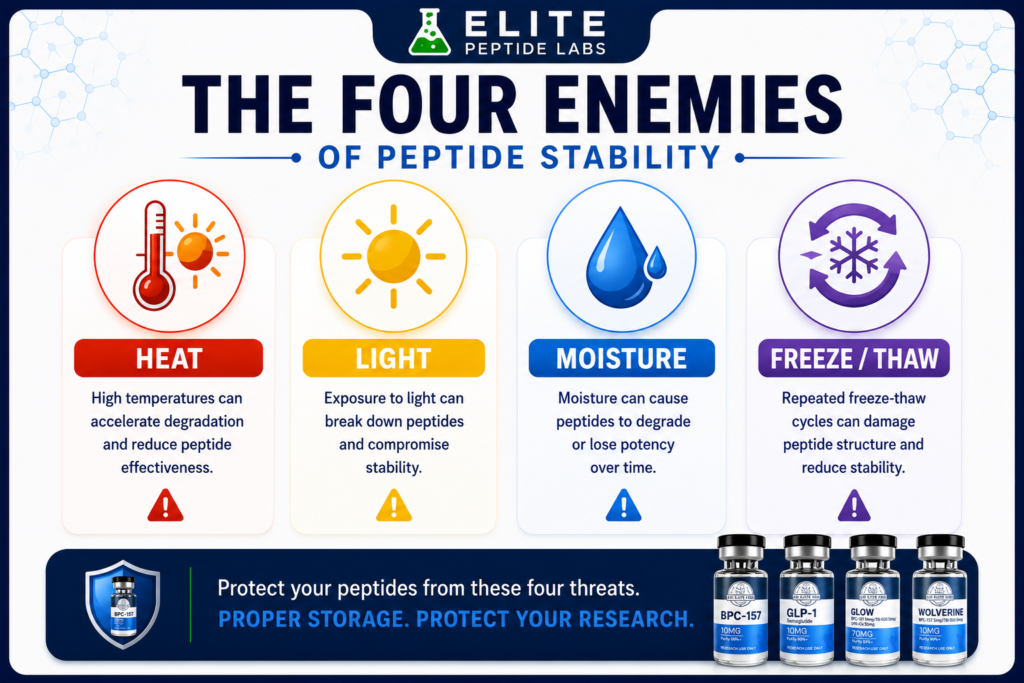
✔ The four biggest storage principles every researcher should know
✔ Common mistakes that are easy to avoid
✔ Practical habits that help create a more consistent laboratory routine
Let’s begin with the simplest question of all…
🚀 Quick Answer
If you’re only here for the short version, here’s the takeaway.
Most lyophilized research peptides are commonly stored according to the storage recommendations provided for the specific compound.
As a general laboratory best practice, researchers often aim to:
✔ Keep vials sealed until they’re ready to be used.
✔ Minimize unnecessary exposure to heat, moisture, and light.
✔ Avoid repeated environmental or temperature changes whenever practical.
✔ Follow product-specific storage guidance rather than assuming every peptide should be handled identically.
That’s really the foundation of how to store research peptides.
Everything else in this guide simply explains why those habits matter.
Why This Guide Exists
One thing we’ve noticed at Elite Peptide Labs is that most online storage guides fall into one of two categories.
Some are so technical that they feel like you’re reading a university textbook.
Others are so short that they leave you with more questions than answers.
We wanted to create something different.
A guide that’s accurate.
Easy to understand.
And genuinely useful.
Whether you’re here for two minutes or twenty, our goal is simple:
Help you leave knowing something you didn’t know before you arrived.
That’s the philosophy behind every publication in the Elite Peptide Labs Research Library.
🧪 Professor Peptide’s First Research Note
“I’ll let you in on a little secret…
When I first started learning about peptide storage, I assumed temperature was the only thing that mattered.
It wasn’t.
The biggest lesson I learned wasn’t about refrigerators or freezers.
It was about consistency.
Small habits repeated every day usually outperform complicated routines that are only followed occasionally.
Good science rarely begins with dramatic moments.
More often, it begins with simple habits done well.”
— Professor Peptide
Chief Research Guide, Elite Peptide Labs
Before We Continue…
If you’ve ever wondered why research peptides are typically supplied as a dry powder instead of a prepared liquid…
Or why researchers often use the word “lyophilized” when discussing storage…
You’re about to find out.
And once you understand that one concept, many of the storage recommendations you’ll read elsewhere will start making much more sense.
➡️ Next: Understanding Lyophilized Research Peptides
Why Proper Storage Matters
Most researchers spend a lot of time deciding what to study.
Which peptide?
Which concentration?
Which protocol?
Those are important decisions.
But there’s another question that deserves just as much attention.
How are those research materials being handled before the work even begins?
It’s easy to think of storage as something that happens in the background.
Put the vial away.
Close the door.
Move on.
In reality, storage is the first step in creating a consistent laboratory routine.
And consistency is something you’ll see come up again and again throughout this guide.
A Simple Way to Think About It
Imagine you’re building a house.
You could buy the highest-quality lumber, the strongest concrete, and the best tools available.
But if the foundation isn’t prepared properly…
Everything built on top of it becomes less reliable.
Laboratory work follows a similar philosophy.
Good preparation doesn’t guarantee success.
But poor preparation can introduce unnecessary problems before your research has even begun.
Storage is part of that preparation.
It’s one of those small habits that often goes unnoticed—until it’s overlooked.
Respect the Research Material
One idea we’d like every reader to take away from this guide is simple:
Treat your research materials with the same care that went into producing them.
Think about everything that happened before a vial reached your laboratory.
Research.
Manufacturing.
Quality control.
Testing.
Packaging.
Shipping.
Every step was designed to help deliver a consistent research product.
Good laboratory handling is simply the next step in that journey.
It’s less about following rigid rules…
…and more about respecting the process.
Why Consistency Beats Perfection
Here’s something that surprises many beginners.
Experienced researchers rarely obsess over being perfect.
Instead…
They focus on being consistent.
A clean workspace.
Clearly labelled materials.
A routine for handling products.
Returning items to storage promptly.
Preparing before opening a vial.
None of those habits are particularly exciting.
But together, they create a workflow that’s easier to repeat—and that’s often where confidence comes from.
The goal isn’t to create a perfect laboratory.
The goal is to create good habits that become automatic.
Laboratory Habits Worth Building
If you’re just starting your research journey, these are a few simple habits that can make day-to-day work feel more organized.
✔ Read the storage recommendations before opening a new product.
✔ Prepare your workspace before removing materials from storage.
✔ Return products to their recommended storage conditions once you’re finished.
✔ Clearly label materials if you’re working with multiple compounds.
✔ Take a moment to organize before you begin instead of rushing through the process.
None of these require special equipment.
Just a little preparation.
Why This Matters More Than You Might Think
It’s tempting to think,
“I’ll only be handling this for a minute.”
And sometimes that minute becomes ten.
Or twenty.
Most storage mistakes don’t happen because someone doesn’t care.
They happen because people are busy.
They’re distracted.
Or they assume they’ll remember to come back in just a moment.
That’s why experienced laboratories often rely on routines rather than memory.
Good systems reduce the need to remember every little detail.
🧪 Professor Peptide’s Research Note
“One of the best lessons I ever learned didn’t come from a textbook.
It came from watching an experienced researcher finish their work.
They never rushed to clean up afterward.
They never said, ‘I’ll organize it later.’
Every vial went back where it belonged.
Every label was checked.
Every workspace was left ready for tomorrow.
At first, I thought they were being overly careful.
Eventually, I realized they were simply making tomorrow’s work easier than today’s.”
— Professor Peptide
Chief Research Guide, Elite Peptide Labs
A Small Investment That Pays Every Day
Good storage habits aren’t just about protecting research materials.
They’re about protecting your time.
An organized workspace reduces confusion.
A consistent routine reduces unnecessary mistakes.
Clear labels reduce second-guessing.
Preparation reduces interruptions.
Individually…
Each habit saves only a few seconds.
Collectively…
They can make your entire workflow feel calmer, more organized, and easier to repeat.
And that’s exactly what good laboratory practice is built on.
Looking Ahead…
Now that we’ve talked about why storage matters, it’s time to answer one of the most common questions beginners ask:
What does “lyophilized” actually mean… and why are most research peptides supplied as a dry powder instead of a liquid?
Once you understand that concept, nearly every storage recommendation you’ll encounter starts to make much more sense.
➡️ Next: Understanding Lyophilized Research Peptides
Understanding Lyophilized Research Peptides
If you’ve spent any time researching peptides, you’ve almost certainly come across the word lyophilized.
At first glance…
It sounds like one of those scientific words that only belongs in a laboratory textbook.
The good news?
The idea behind it is actually quite simple.
Once you understand what lyophilization is—and why it’s used—many of the storage recommendations you’ll encounter throughout the peptide industry suddenly make much more sense.
Let’s break it down together.
So… What Does “Lyophilized” Mean?
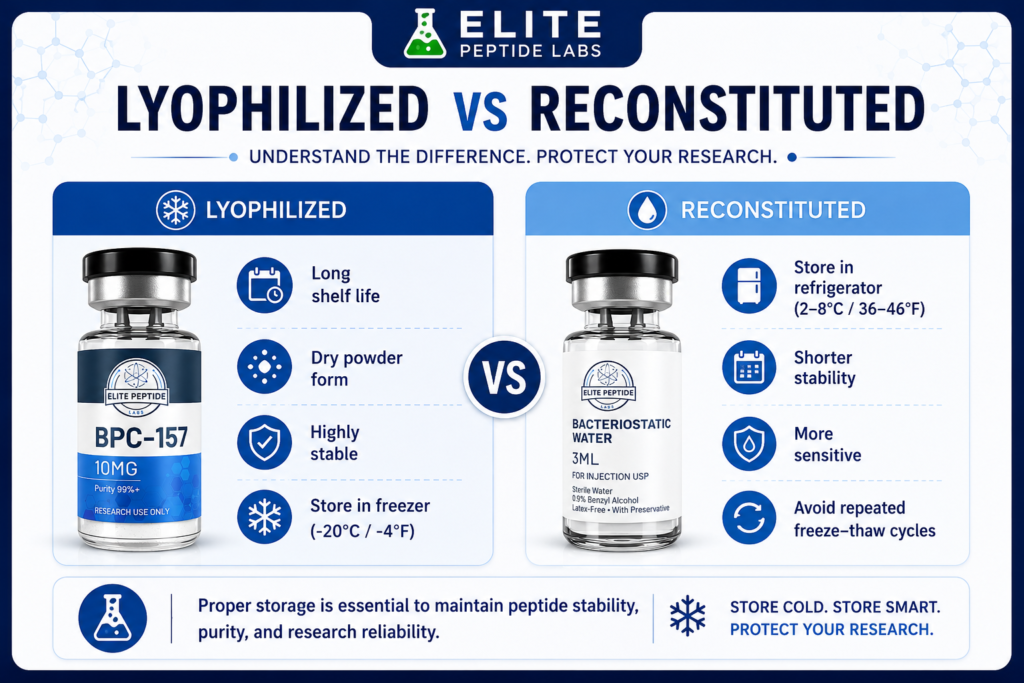
In simple terms, lyophilization is a specialized freeze-drying process.
During this process, water is removed from a material under carefully controlled laboratory conditions.
The result is a dry powder rather than a liquid.
That’s why many research peptides arrive as a small white powder inside a sealed vial instead of being supplied already mixed.
Removing water generally helps improve stability during storage and transportation compared with keeping the material in solution.
Think of it as preparing the material for its journey before it reaches the laboratory.
A Familiar Example
Let’s step away from science for a moment.
Imagine buying two identical bags of premium coffee beans.
One bag is sealed immediately after roasting.
The other is left open on the kitchen counter for several days.
Even without knowing anything about coffee…
Most people can guess which one is likely to stay fresher.
Why?
Because protecting something from unnecessary exposure usually helps preserve its quality.
The same general idea applies to many laboratory materials.
The goal isn’t simply to make something “cold.”
The goal is to protect it until it’s ready to be used according to the appropriate laboratory procedures.
Sometimes the simplest comparisons are the easiest to remember.
Why Not Just Sell Every Peptide as a Liquid?
That’s an excellent question.
And it’s one we hear quite often.
If a prepared liquid seems more convenient…
Why go through the extra effort of producing a dry powder?
The answer comes down to one word:
Stability.
Removing water generally helps improve the stability of many research materials during shipping and storage.
It also allows researchers to prepare the material when it’s needed rather than long before it’s reaches the laboratory.
Although handling recommendations can vary depending on the specific compound, supplying many research peptides in a lyophilized form has become common practice across the industry for exactly these reasons.
Why the White Powder Looks Different from Vial to Vial
Here’s something that sometimes surprises new researchers.
Not every lyophilized peptide looks exactly the same.
One vial may contain a compact “cake.”
Another may appear more powder-like.
Some products look almost fluffy.
Others appear smooth and dense.
In many cases, these visual differences are simply the result of the manufacturing and lyophilization process rather than an indication that something is wrong.
That’s one reason it’s generally a good idea to avoid judging a research material based solely on appearance.
Instead…
Focus on sourcing from reputable suppliers that emphasize quality standards, testing, and consistency.
It’s Not Just About Storage
Many people assume lyophilization exists only to make storage easier.
In reality…
It’s also about transportation.
Imagine a research peptide traveling hundreds or even thousands of kilometres before arriving at its destination.
Throughout that journey it may experience different environments, handling conditions, and transit times.
Providing many research peptides in a lyophilized form helps prepare them for that journey.
Once the material reaches your laboratory, your role becomes much simpler:
Continue treating it with the same level of care.
🧪 Professor Peptide’s Research Note
“One mistake I made early on was thinking scientific words had to sound complicated to be important.
Then I realized something.
The best scientists I’ve met were usually the best teachers.
They could explain difficult ideas using everyday language without losing accuracy.
That’s become one of my favourite goals.
If we can make science easier to understand without oversimplifying it…
We’ve done our job.”
— Professor Peptide
Chief Research Guide, Elite Peptide Labs
The Big Takeaway
If you remember only one thing from this section…
Remember this:
Lyophilization isn’t just a manufacturing step.
It’s part of protecting research materials before they ever reach your laboratory.
Understanding that makes many of the storage recommendations you’ll read throughout the peptide research community much easier to understand.
Once you know why the material arrives as a dry powder…
The rest of the storage guide begins to fit together naturally.
Looking Ahead…
Now that we understand what lyophilization is, let’s move on to the practical part.
What should you actually do once your research peptides arrive?
Should they go straight into the refrigerator?
Does light matter?
What about moisture?
And what simple habits can help create a more consistent laboratory routine?
➡️ Next: Storage Best Practices Every Researcher Should Know
The Journey of a Research Peptide
🧪 Manufacturing
↓
❄️ Lyophilization
↓
🧪 Quality Control
↓
📦 Packaging
↓
🚚 Shipping
↓
📬 Safe Arrival
Storage Best Practices Every Researcher Should Know
Now that we’ve covered why storage matters and what lyophilization actually means, let’s move on to the practical side of things.
This is where many people expect a long list of complicated rules.
Fortunately…
Good laboratory storage is usually much simpler than that.
Rather than trying to memorize dozens of individual recommendations, it’s often easier to remember a few guiding principles.
Think of them as good habits rather than strict rules.
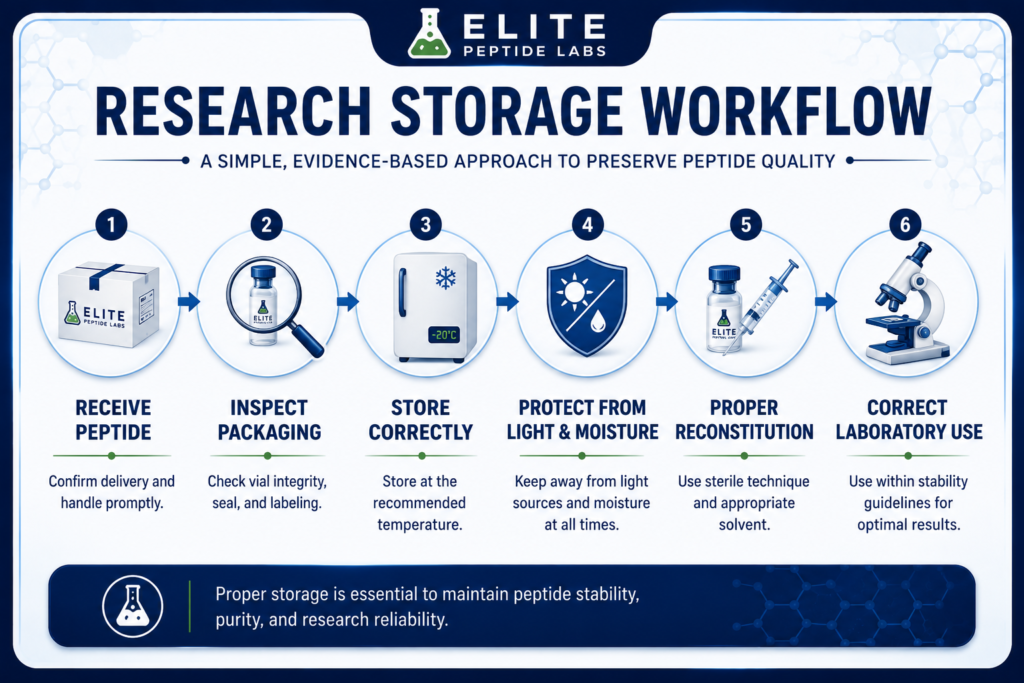
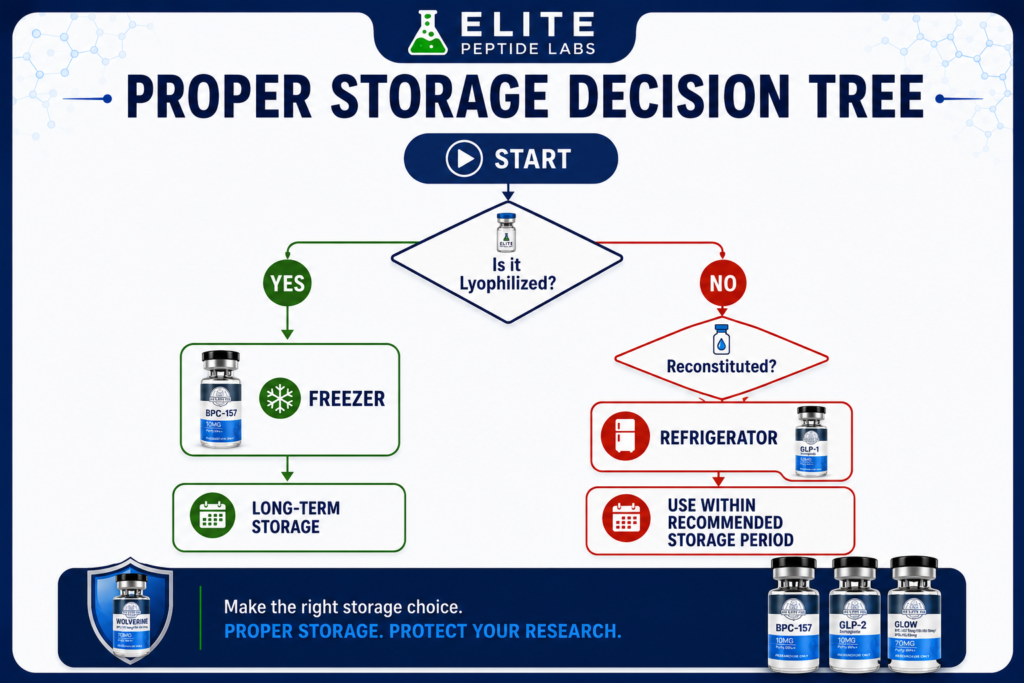
Principle 1: Start With the Product’s Storage Recommendations
If there’s one lesson we’d like every reader to remember, it’s this:
Not every research peptide should be treated exactly the same.
Different compounds may have different storage recommendations depending on their characteristics and intended laboratory use.
That’s why the first step on how to store research peptides is always the simplest one:
Read the storage guidance provided for the specific product you’re working with.
It only takes a minute…
And it removes a lot of unnecessary guesswork.
Principle 2: Keep Vials Sealed Until They’re Needed
Remember what we learned in the previous section about how to store research peptides.
Many research peptides are supplied as a lyophilized powder to help improve stability during storage and transportation.
Keeping the vial sealed until you’re ready to begin your laboratory work helps maintain that protective environment.
Think of it like opening a brand-new notebook.
Once it’s opened, the pages are exposed.
The notebook still works perfectly…
But it’s no longer in the exact same condition as when it left the factory.
Research materials deserve that same level of care.
Principle 3: Minimize Unnecessary Moisture Exposure
One of the reasons many peptides are supplied in a lyophilized form is because water has already been removed during manufacturing.
Protecting the material from unnecessary moisture exposure before preparation is simply an extension of that process.
That doesn’t mean becoming overly worried every time you handle a vial.
It simply means being intentional.
Good laboratory practice is usually built on thoughtful preparation rather than rushed decisions.
Principle 4: Consistency Matters More Than Perfection
This has quietly become one of the biggest themes throughout this guide.
Researchers sometimes ask,
“What’s the perfect storage routine?”
The truth is…
There probably isn’t one perfect routine for every laboratory.
There is, however, something that’s usually much more valuable.
Consistency.
Returning materials to their recommended storage conditions.
Keeping a tidy workspace.
Following the same routine each time.
Small habits like these are easier to maintain over months and years than complicated systems that nobody actually follows.
Principle 5: Prepare Before You Open Anything
This is one of the simplest habits you can build.
Before opening a vial, ask yourself a few quick questions.
✔ Is my workspace ready?
✔ Do I have everything I need?
✔ Am I rushing?
If the answer to that last question is “yes”…
Take thirty seconds.
Those thirty seconds often save far more time later.
Preparation reduces interruptions.
Interruptions increase mistakes.
Good researchers understand that slowing down for a moment often means moving faster overall.
A Helpful Way to Remember It
Instead of trying to remember every detail in this guide…
Remember these five words:
Read.
Prepare.
Protect.
Store.
Repeat.
That’s the foundation of a consistent storage routine.
And fortunately…
It’s also easy to remember.
🧪 Professor Peptide’s Research Note
“One of the biggest myths about good laboratory work is that experienced researchers never make mistakes.
They do.
The difference is that they’ve built systems that make mistakes less likely.
Labels.
Checklists.
Organized workspaces.
Consistent routines.
Those aren’t signs of being overly careful.
They’re signs of respecting the work.”
— Professor Peptide
Chief Research Guide, Elite Peptide Labs
Elite Peptide Labs Research Tip
💡 A good routine should be easy to repeat.
If your storage process feels overly complicated, ask yourself whether it can be simplified without sacrificing good laboratory practice.
The easier a routine is to follow…
The more likely you’ll continue following it consistently.
Looking Ahead…
By now, you’ve probably noticed something interesting about how to store research peptides.
Most storage mistakes don’t happen because people lack information.
They happen because people are busy.
They rush.
Or they assume,
“I’ll only leave this out for a minute.”
In the next section, we’ll look at five of the most common storage mistakes researchers make—and more importantly, how easy they are to avoid.
➡️ Next: Five Common Storage Mistakes (And How to Avoid Them)
Five Common Storage Mistakes (And How to Avoid Them)
One of the biggest misconceptions about laboratory storage is that mistakes only happen to beginners.
In reality…
Even experienced researchers occasionally overlook simple things.
Not because they lack knowledge.
Because they’re busy.
They’re distracted.
Or they’re simply following habits they haven’t thought about in a while.
The good news?
Most storage mistakes are surprisingly easy to avoid once you know what to look for.
Let’s look at the five we see discussed most often.
Mistake #1: Assuming Every Peptide Is Stored the Same Way
This is probably the most common misconception.
Someone learns how one research peptide is commonly stored…
Then assumes every other peptide follows the exact same recommendations.
Unfortunately, research materials don’t always work that way.
Different compounds may have different storage recommendations, handling considerations, or preparation procedures.
That’s why one simple habit can prevent countless mistakes:
Always review the guidance provided for the specific product you’re working with.
It only takes a minute.
And it’s one of the easiest ways to build confidence in your laboratory routine.
Mistake #2: Waiting Until the Last Minute to Prepare
Picture this.
You’ve decided it’s time to begin your work.
You remove the vial from storage.
Then you realize…
You still need to find your notebook.
Gather your supplies.
Clear your workspace.
Locate your labels.
Before you know it, several minutes have passed.
Experienced researchers often reverse that process.
They prepare first.
Then remove the materials they’re ready to use.
It’s a small change…
But one that can make your workflow feel much more organized.
Mistake #3: Treating Storage as an Afterthought
Sometimes how to store research peptides becomes the final task on the list.
Research first.
Cleanup later.
Storage somewhere in between.
Instead…
Try thinking about storage as part of the research process itself.
Good storage isn’t something you remember at the end.
It’s something that’s built into your routine from the beginning.
That mindset shift alone can make good habits much easier to maintain.
Mistake #4: Relying on Memory Instead of Systems
We’ve all done it.
“I’ll remember where I put that.”
“I’ll label it later.”
“I’ll only be a minute.”
Those decisions usually seem harmless in the moment.
The challenge is that memory isn’t a laboratory system.
Checklists are.
Labels are.
Organized workspaces are.
The best laboratories don’t depend on perfect memories.
They depend on repeatable systems.
Mistake #5: Believing That Good Habits Don’t Matter
This one might be the most surprising.
Many people assume that because a habit feels small…
It probably isn’t important.
In reality…
Small habits repeated consistently often create the biggest long-term improvements.
Taking an extra moment to prepare.
Returning materials promptly.
Checking a label one more time.
None of these actions feel dramatic.
But together…
They create a laboratory routine that’s calmer, more organized, and easier to repeat.
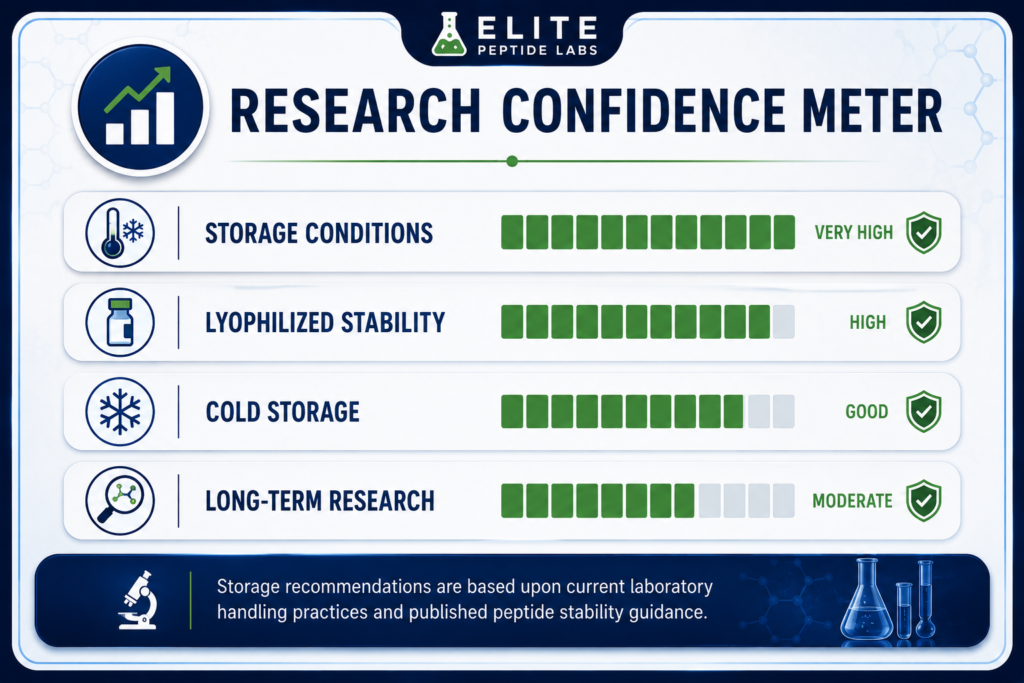
🧪 Research Confidence Meter
One thing you’ll notice throughout the Elite Peptide Labs Research Library is that we’ll always distinguish between well-established laboratory principles and areas where recommendations can vary depending on the specific research material.
| Topic | Current Confidence |
|---|---|
| Following product-specific storage recommendations | 🟢🟢🟢🟢🟢 Well Established |
| Benefits of keeping organized laboratory routines | 🟢🟢🟢🟢🟢 Well Established |
| Reading manufacturer guidance before handling materials | 🟢🟢🟢🟢🟢 Well Established |
| Assuming every peptide should be handled identically | 🔴 False Assumption |
One thing you’ll never see us do is present every recommendation as though it applies equally to every compound.
Good science is nuanced.
Our educational content should reflect that.
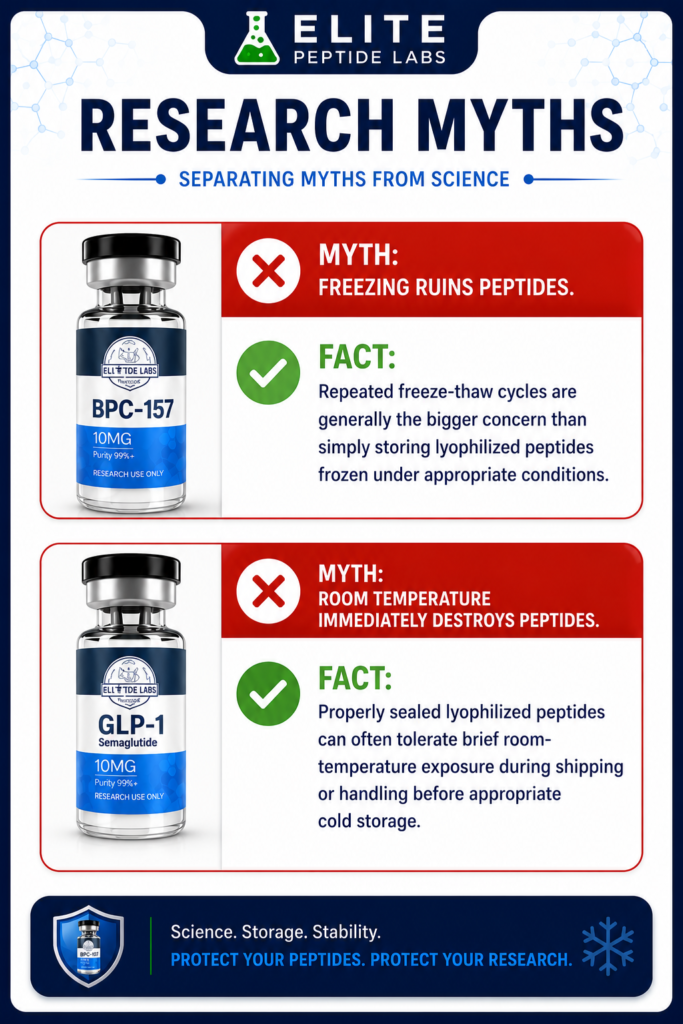
Myth vs. Reality
❌ Myth:
“If I remember the basics, I don’t need to know how to store research peptides.”
✅ Reality:
Even experienced researchers review product-specific guidance because different compounds can have different handling considerations.
❌ Myth:
“Good laboratory work is about never making mistakes.”
✅ Reality:
Good laboratory work is about building systems that make mistakes less likely.
❌ Myth:
“Storage is just something you do after the important work.”
✅ Reality:
Storage is part of the research process—not something separate from it.
🧪 Professor Peptide’s Research Note
“One of my mentors used to tell me something I’ll never forget.
‘Don’t trust your memory.
Trust your system.’
At first, I thought that sounded a little pessimistic.
Then I realized it was actually freeing.
Good systems let you spend less time worrying about the little things…
And more time thinking about the science.”
— Professor Peptide
Chief Research Guide, Elite Peptide Labs
Elite Peptide Labs Research Tip
💡 Ask yourself one simple question before finishing for the day:
“If I walked back into this workspace tomorrow morning, would everything be exactly where I’d expect it to be?”
If the answer is yes…
You’re already building habits that many experienced researchers rely on every day. This article should help you know exactly how to store research peptides going forward.
Looking Ahead…
By now, we’ve covered the fundamentals of proper storage, explained why lyophilized peptides are commonly supplied as a dry powder, and explored the habits that help create a consistent laboratory routine.
In the next section, we’ll answer the questions we hear most often.
From refrigeration and moisture to handling and preparation, we’ll tackle the most common storage questions in a straightforward, beginner-friendly FAQ.
➡️ Next: Frequently Asked Questions About Research Peptide Storage
Frequently Asked Questions About Research Peptide Storage
If you’ve made it this far…
You’ve already learned more about peptide storage than most short online guides ever cover.
But there are still a few questions that come up again and again.
Let’s answer them.
❓ Should Research Peptides Always Be Refrigerated?
Not necessarily.
One of the biggest misconceptions in peptide research is that every research peptide follows exactly the same storage recommendations.
Different compounds may have different recommended storage conditions depending on the product and manufacturer.
That’s why the safest habit is also the simplest:
Always follow the storage guidance provided for the specific product you’re working with.
If you’re unsure…
Take a moment to verify before making assumptions.
❓ Does Leaving a Vial Out for a Few Minutes Ruin It?
This is one of those questions that usually comes from people who genuinely care about doing things correctly.
Routine laboratory handling is expected.
The goal isn’t to create unnecessary anxiety over every minute.
Instead…
Focus on building consistent habits.
Prepare your workspace before you begin.
Handle materials thoughtfully.
Return products to their recommended storage conditions once you’re finished.
Consistency matters far more than perfection.
❓ Why Are Research Peptides Usually Supplied as a Powder Instead of a Liquid?
Great question.
Most research peptides are commonly supplied as a lyophilized powder because removing water generally improves stability during storage and transportation compared with keeping the material in solution.
It also allows preparation to take place when appropriate for the laboratory workflow rather than long before the material reaches its destination.
That’s why you’ll often see a small white powder inside the vial.
It’s not unusual.
It’s expected.
❓ Why Doesn’t Every Lyophilized Vial Look Exactly the Same?
This surprises a lot of beginners.
Some lyophilized peptides appear as a smooth “cake.”
Others look fluffy.
Some settle differently inside the vial.
These visual differences can simply result from the manufacturing and lyophilization process.
Appearance alone isn’t a reliable way to judge quality.
Instead…
Focus on purchasing from suppliers that prioritize quality standards, product consistency, and appropriate testing.
❓ How to Store Research Peptides Without Common Mistakes?
Interestingly…
It’s usually not temperature.
It’s rushing.
Opening a vial before preparing the workspace.
Assuming every peptide is handled the same way.
Planning to label something “later.”
These aren’t knowledge problems.
They’re habit problems.
The good news?
Habits are much easier to improve than most people think.
❓ Is Freezing Always Better Than Refrigeration?
Not necessarily.
Different research materials may have different recommended storage conditions.
That’s why we intentionally avoid blanket statements throughout this guide.
The most responsible answer is usually:
Follow the storage guidance provided for the specific research material.
Simple.
Reliable.
And easy to remember.
❓ Why Do Experienced Researchers Like Checklists So Much?
Because checklists remove guesswork.
Pilots use them.
Surgeons use them.
Laboratories use them.
Not because experts forget everything…
But because good systems reduce the chance of overlooking small details.
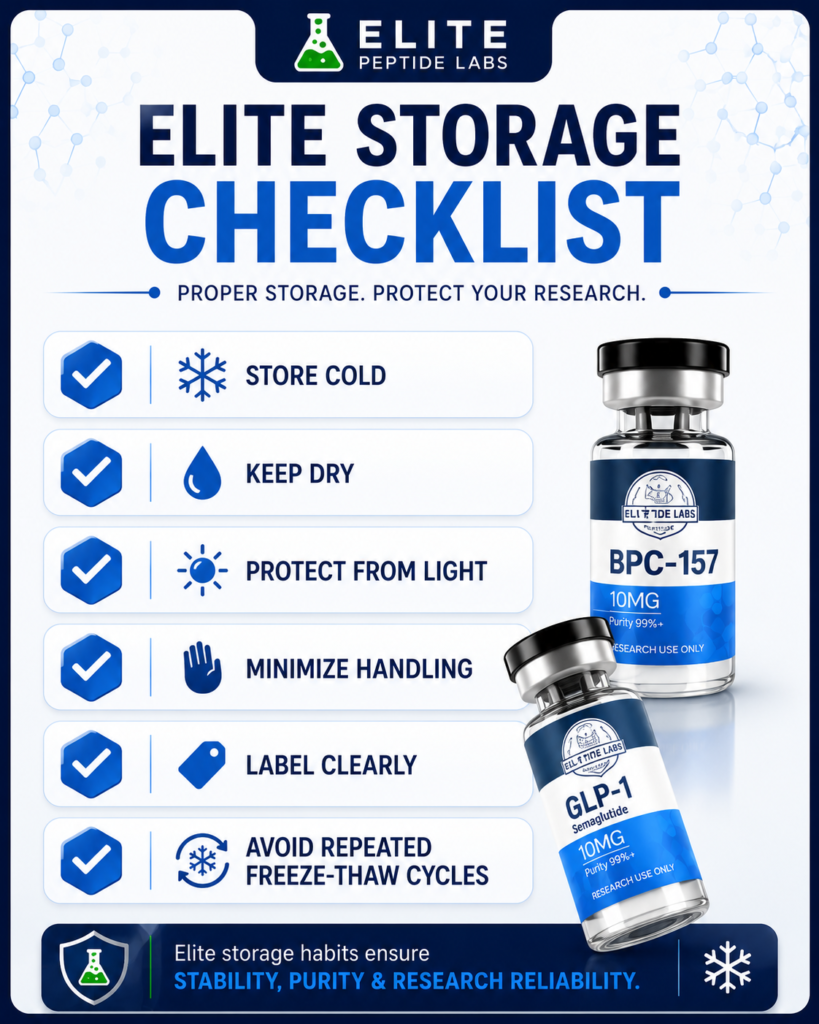
That’s exactly why we’ve included the Elite Peptide Labs Research Storage Checklist later in this guide.
❓ Where Can I Learn More?
If this guide answered one question…
We hope it inspired a few more.
The Elite Peptide Labs Research Library is designed to grow over time with beginner-friendly educational guides covering topics such as:
🔬 BPC-157
🧬 GHK-CU
🧠 Semax
⚡ MOTS-c
💙 NAD+
💧 Bacteriostatic Water
📖 Peptide Reconstitution
Every article is written with the same goal:
Helping curious researchers become more confident researchers.
🧪 Professor Peptide’s Research Note
“One of my favourite questions has always been, ‘Why?’
Why is it stored this way?
Why is it supplied as a powder?
Why does this recommendation exist?
The moment you stop asking ‘Why?’…
Learning slows down.
Curiosity is one of the most valuable tools any researcher can develop.
Never lose it.”
— Professor Peptide
Chief Research Guide, Elite Peptide Labs
Quick Recap
Before moving on…
Here’s everything we’ve covered so far.
✅ Why proper storage matters
✅ What lyophilization means
✅ Why peptides are commonly supplied as a dry powder
✅ Five practical storage principles
✅ Common mistakes and how to avoid them
✅ Answers to the questions researchers ask most often
That’s a strong foundation.
Now let’s turn all of that knowledge into something practical.
Looking Ahead…
Reading about good laboratory habits is one thing.
Applying them consistently is another.
In the next section, we’ll bring everything together with a simple tool you can actually use:
The Elite Peptide Labs Research Storage Checklist.
It’s designed to take everything you’ve learned in this guide and turn it into an easy-to-follow routine you can refer back to whenever you need it.
➡️ Next: The Elite Peptide Labs Research Storage Checklist
The Elite Peptide Labs Research Storage Checklist
Congratulations.
If you’ve read this guide from beginning to end, you’ve already built a strong foundation for understanding proper peptide storage.
Now let’s simplify everything into something you can actually use.
Think of this checklist as a quick reminder rather than a strict set of rules.
The goal isn’t perfection.
The goal is building consistent habits that become second nature over time.
✅ Before Your Research Materials Arrive
A little preparation goes a long way.
Before your shipment arrives, ask yourself:
☐ Do I know the recommended storage guidance for the products I’ve ordered?
☐ Is my storage area clean, organized, and ready?
☐ Do I have everything I’ll need when I’m ready to begin?
Being prepared before your package arrives makes the entire process feel smoother.
📦 When Your Package Arrives
Receiving your shipment is exciting.
It’s also the perfect time to slow down for just a moment.
Take a quick look at the package.
✔ Is everything intact?
✔ Are the correct products present?
✔ Does everything appear as expected?
Once you’ve confirmed everything looks good, follow the storage guidance for each product.
Simple.
No guesswork.
🧪 Before Opening a Vial
This might be the easiest habit to build—and one of the most valuable.
Before opening anything, ask yourself:
☐ Is my workspace ready?
☐ Do I have everything I need?
☐ Am I rushing?
If the answer to that last question is “yes”…
Pause for a moment.
Thirty seconds of preparation often saves far more time later.
🔬 During Your Laboratory Work
While you’re working:
✔ Keep your workspace organized.
✔ Handle research materials thoughtfully.
✔ Avoid unnecessary interruptions whenever practical.
✔ Return products to their recommended storage conditions once you’re finished.
Notice something?
None of these habits are difficult.
They’re simply consistent.
📋 Before Finishing for the Day
Here’s one final routine that many experienced researchers naturally develop.
Before leaving your workspace, take sixty seconds to ask:
☐ Is everything labelled clearly?
☐ Are materials back in their recommended storage conditions?
☐ Is the workspace ready for tomorrow?
Think of it as a gift to your future self.
Tomorrow’s work becomes much easier when today’s work ends well.
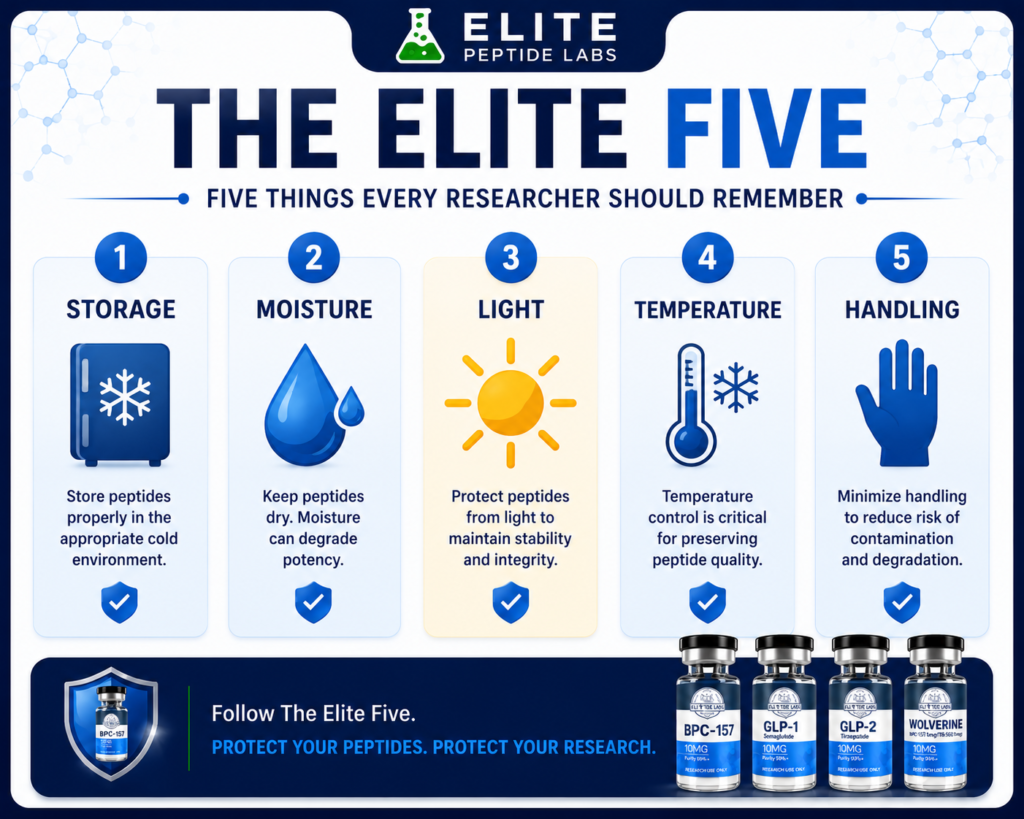
The Elite Five
If you only remember five ideas from this entire guide…
Remember these.
📖 Read
Review the storage guidance for the specific product you’re working with.
🛠 Prepare
Organize your workspace before beginning.
🛡 Protect
Minimize unnecessary exposure to environmental factors while following product-specific guidance.
📦 Store
Return materials to their recommended storage conditions when finished.
🔁 Repeat
Consistency is what turns good habits into excellent laboratory routines.
Continue Your Research
Learning doesn’t stop with one article.
In fact…
This guide is designed to be the beginning of your journey through the Elite Peptide Labs Research Library.
If you enjoyed this guide, you may also like:
🧬 What Is BPC-157? (Coming Soon)
💧 What Is Bacteriostatic Water? (Coming Soon)
🧪 Peptide Reconstitution Guide (Coming Soon)
🧠 Understanding Semax (Coming Soon)
⚡ What Is MOTS-c? (Coming Soon)
💙 Understanding NAD+ Research (Coming Soon)
Every guide builds on the last.
Together, they’re designed to help you become a more informed and confident researcher.
Products Mentioned in This Guide
Throughout this article we’ve discussed several research compounds and laboratory materials.
If you’d like to learn more, you can explore:
Research-Grade Bacteriostatic Water
🧪 Professor Peptide’s Final Research Note
“If I could leave you with one piece of advice…
It wouldn’t be about storage.
Or temperature.
Or laboratory equipment.
It would simply be this:
Stay curious.
Curiosity is what makes people ask one more question.
Read one more paper.
Double-check one more detail.
Learn one more concept.
Research doesn’t move forward because someone thinks they know everything.
It moves forward because someone decides to keep learning.
I hope this guide is just the beginning of that journey.”
— Professor Peptide
Chief Research Guide, Elite Peptide Labs
Looking Ahead…
You’ve now learned the principles of proper storage, the purpose of lyophilization, common mistakes to avoid, and practical habits that help build a more consistent laboratory routine.
In our final section, we’ll wrap everything together with:
Founder’s Principle
Final thoughts
About the Elite Peptide Labs Research Library
Research use disclaimer
Continuous improvement statement
Final Thoughts
If you’ve reached the end of this guide…
Thank you.
Seriously.
In a world where most people skim headlines and move on after thirty seconds, you’ve taken the time to understand not just what good storage practices look like—but why they matter.
And that matters to us.
Because at Elite Peptide Labs, we believe education is one of the most valuable things we can provide.
Whether you’re just beginning to explore peptide research or you’ve spent years working with research materials, every question you ask is another opportunity to learn.
Every guide we publish is written with that same goal in mind.
Not to overwhelm.
Not to impress.
But to explain.
Clearly.
Honestly.
And in a way that’s genuinely useful.
Our Commitment to You
When we created the Elite Peptide Labs Research Library, we made a simple promise.
Every article should leave readers more informed than when they arrived.
That means:
✔ Explaining scientific concepts in plain language.
✔ Being honest about what is well established and where recommendations may differ.
✔ Avoiding sensational claims.
✔ Continuing to improve our educational content over time.
We don’t believe knowledge should feel intimidating.
We believe it should feel accessible.
This Is Only the Beginning
This guide is the first publication in what we hope becomes one of the most comprehensive educational resources in the peptide research community.
In the months ahead, we’ll continue expanding the Research Library with practical, beginner-friendly guides covering topics such as:
🧬 Understanding BPC-157
💧 What Is Bacteriostatic Water?
🧪 Peptide Reconstitution
🧠 Understanding Semax
⚡ Exploring MOTS-c
💙 NAD+ Research
📚 Laboratory Terminology
🔬 Beginner’s Guide to Peptide Research
Every article will build on the last.
Not because we want readers to stay on our website longer…
But because understanding grows one question at a time.
🧪 A Note From Professor Peptide
“One of the things I enjoy most about science is that nobody ever reaches the finish line.
Every answer leads to another question.
Every discovery opens another door.
That’s what makes learning so exciting.
So wherever you are in your research journey…
Keep asking questions.
Keep reading.
Keep learning.
Because curiosity has always been one of science’s greatest discoveries.”
— Professor Peptide
Chief Research Guide, Elite Peptide Labs
About the Elite Peptide Labs Research Library
The Elite Peptide Labs Research Library was created to make peptide research more approachable through clear, evidence-based educational content.
Our mission is to help readers better understand laboratory concepts, research compounds, and scientific terminology in a way that’s practical, engaging, and easy to follow.
Every publication is developed with one goal in mind:
Helping curious researchers become more confident researchers.
Research Use Disclaimer
The information provided in the Elite Peptide Labs Research Library is intended for educational and informational purposes only.
Products offered by Elite Peptide Labs are supplied strictly for laboratory research use and are not intended for human consumption, therapeutic use, diagnosis, or treatment.
Readers should always follow the product-specific information provided with each research material and ensure that all work is conducted in accordance with applicable laws, regulations, and institutional policies.
References:
ICH stability guidelines
United States Pharmacopeia Wikipedia (USP)
FDA guidance on sterile laboratory practices
About This Guide
The Elite Peptide Labs Research Library is designed to grow alongside scientific knowledge.
As new research becomes available, this guide may be updated to improve explanations, expand educational content, correct inaccuracies, or incorporate helpful feedback from our readers.
Version numbers allow us to continually refine our publications while maintaining transparency about meaningful updates.
Today’s publication is:
RL-001 – Version 1.0
And like every great research project…
It’s only the beginning.
Founder’s Principle
“Our products are our promise. The experience is how people remember that promise.”
— Elite Peptide Labs Canada CEO
That single idea influences everything we create.
The products we develop.
The educational resources we publish.
The support we provide.
The partnerships we build.
And the experience we hope every visitor has from the moment they arrive until the moment they leave.
Because earning trust isn’t accomplished through one article or one product.
It’s built through hundreds of thoughtful interactions over time.
Thank You
Whether this is your first visit to Elite Peptide Labs or one of many, thank you for choosing to spend part of your day learning with us.
We hope this guide answered your questions.
More importantly…
We hope it inspired a few new ones.
We’ll be here when you’re ready.
Happy researching.