

The Complete Research Guide to Retatrutide

RL-003
Understanding One of the Most Exciting Areas of Modern Metabolic Research
Research Snapshot
| Reader Info | Complete Research Guide to Retatrutide |
|---|---|
| 📖 Reading Time | ⏱ 29–34 Minutes |
| 🎯 Difficulty | 🟢 Beginner Friendly |
| 🧪 Category | Laboratory Guide |
| 📅 Last Updated | July 2026 Version 1.0 |
| 🏢 Published By | 📚 Elite Peptide Labs Research Library |
Few research peptides have generated as much scientific attention in recent years as Retatrutide.
Open almost any discussion about metabolic research…
Browse recent scientific news on weight loss…
Read conversations about next-generation peptide therapeutics…
…and sooner or later, the name Retatrutide appears.
For some, it’s described as the future of metabolic research.
Others call it one of the most exciting investigational peptides currently being studied.
And online, it’s often discussed with a level of certainty that the published science hasn’t yet reached.
That creates an important question.
So… what makes Retatrutide different?
Why has this single molecule attracted so much attention from researchers around the world?
What makes it different from earlier GLP-1 research compounds?
Why are scientists investing so much effort into understanding how it works?
And perhaps most importantly…
What conclusions can actually be drawn from today’s evidence—and which questions are still waiting to be answered?
Those are the questions that matter.
They’re also the reason this guide exists.
The internet has made scientific information more accessible than ever before.
Unfortunately…
It has also made it much easier for speculation to spread faster than evidence.
A single research finding can become a viral headline.
A preliminary observation can quickly turn into a confident prediction.
And before long, separating established science from enthusiasm becomes surprisingly difficult.
At Elite Peptide Labs, we believe scientific literacy begins with understanding the evidence—not the headlines.
Throughout this guide, we’ll examine what researchers currently know about Retatrutide, why it has attracted so much interest, how its unique biology differs from earlier compounds, and where important scientific uncertainties still remain.
Because the strongest conclusions are built on evidence, not excitement.
Every meaningful scientific discovery starts with a question.
Let’s begin there.
⚡ Quick Overview
Retatrutide is an investigational research peptide that simultaneously activates three important metabolic signalling pathways:
- GLP-1 receptors
- GIP receptors
- Glucagon receptors
This unique triple-agonist design has made Retatrutide an important area of investigation for researchers studying energy metabolism, appetite regulation, glucose homeostasis, and body-weight physiology.
Although early research has produced encouraging findings in several areas, Retatrutide remains an active field of investigation, with many biological mechanisms and long-term questions continuing to be explored.
🧪 Professor Peptide
“Science moves forward one carefully tested question at a time. Curiosity starts the journey—evidence decides where it leads.”
What You’ll Learn In This Guide
By the end of this guide, you’ll have a clearer understanding of:
✅ What Retatrutide is and how it was developed.
✅ Why triple-receptor agonists represent a different research approach.
✅ The biological roles of GLP-1, GIP, and glucagon signalling.
✅ What current laboratory and clinical studies have demonstrated.
✅ Why Retatrutide has become one of the most discussed research peptides today.
✅ Common misconceptions found online.
✅ How to critically interpret new scientific findings.
✅ Where future Retatrutide research may be heading.
Whether you’re new to peptide science or already familiar with metabolic research, this guide is designed to help you understand what the evidence shows today while recognizing where scientific knowledge continues to evolve.
Why This Guide Takes a Different Approach
Many articles about Retatrutide begin by making bold predictions.
Others focus almost entirely on headlines.
Some simplify an incredibly complex area of biology into a few sweeping conclusions.
We think there’s a better approach.
Instead of asking “What should I believe?”, we ask:
“What has the research actually demonstrated?”
That’s the philosophy behind every guide in the Elite Peptide Labs Research Library.
We don’t publish articles to chase trends.
We publish them to help readers understand the science, evaluate new evidence with confidence, and appreciate how scientific knowledge develops over time.
Because today’s strongest hypothesis is still only the beginning of tomorrow’s research.
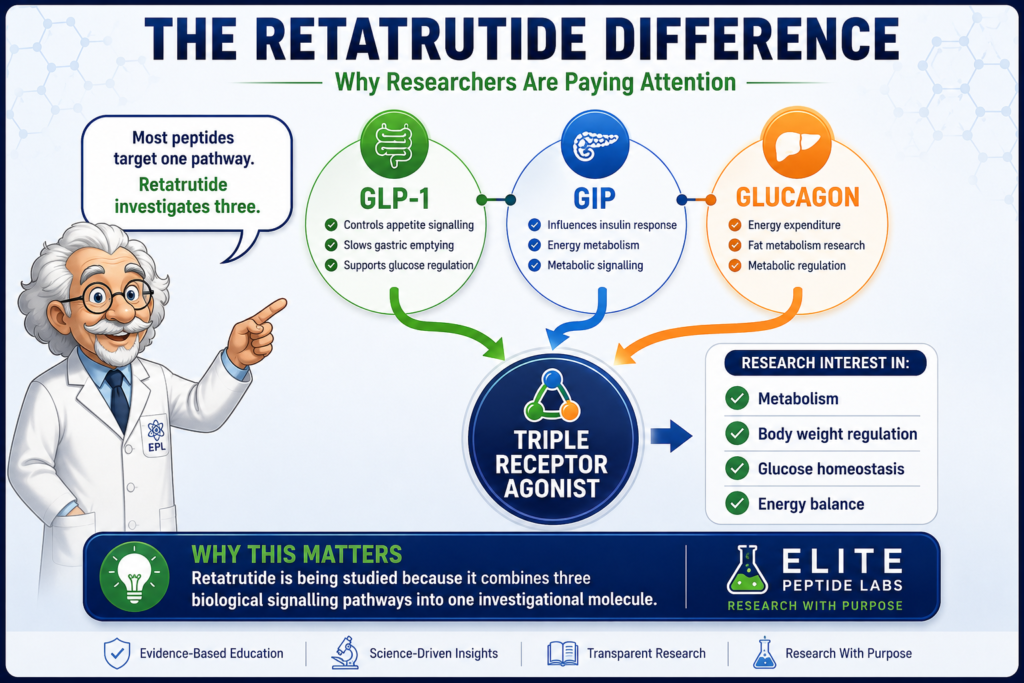
What exactly is Retatrutide?
Retatrutide is an investigational research peptide that has generated significant scientific interest because of something researchers had not previously been able to study in a single molecule.
Unlike earlier metabolic research compounds that primarily activate one—or in some cases two—biological signalling pathways, Retatrutide was specifically designed to investigate the effects of stimulating three separate receptors simultaneously.
Those receptors are:
• GLP-1 (Glucagon-Like Peptide-1)
• GIP (Glucose-Dependent Insulinotropic Polypeptide)
• Glucagon
Because of this unique design, Retatrutide is often described in scientific literature as a triple receptor agonist.
That single phrase has become one of the biggest reasons researchers around the world have become interested in studying it.
Why does activating three receptors matter?
Every receptor involved in metabolism performs a different job.
Think of them as members of the same research team.
Each contributes different information.
Each influences different biological processes.
Each communicates with different organs throughout the body.
Earlier generations of investigational peptides focused on one receptor.
Later compounds explored combinations of two.
Retatrutide represents another step in that scientific progression by allowing researchers to investigate what happens when all three signalling pathways are activated together.
That doesn’t automatically make it “better.”
It simply makes it different.
And in science, different often leads to new questions worth exploring.
🧪 Professor Peptide
“Good researchers don’t become excited because something is new.
They become excited because it lets them ask new scientific questions.”
Why was Retatrutide developed?
Scientists have spent decades trying to better understand how the body regulates:
✔ Appetite signalling
✔ Blood glucose regulation
✔ Energy expenditure
✔ Fat metabolism
✔ Body weight regulation
These systems don’t operate independently.
Instead, they constantly communicate with one another through hormones released from the digestive tract, pancreas, liver, adipose tissue, and nervous system.
Studying only one pathway at a time provides valuable information.
But it also leaves important questions unanswered about how these systems interact.
Retatrutide was developed as an investigational molecule to help researchers examine those interactions in a more integrated way.
That makes it valuable—not because it promises answers—but because it provides another tool for exploring complex metabolic biology.
Scientific curiosity drives innovation
Every major scientific discovery begins with a question.
Sometimes researchers discover something entirely unexpected.
Other times, new molecules are created specifically to investigate biological systems that existing compounds cannot fully explain.
Retatrutide belongs to the second category.
Its value to science lies in the opportunity it provides to investigate multiple signalling pathways together, generating data that may improve our understanding of metabolism and endocrine physiology.
As with all investigational compounds, however, the conclusions must come from carefully conducted research—not assumptions.
Transition to the next section
Now that we understand what Retatrutide is, the next logical question becomes:
Where did it come from?
Who developed it…
Why was it created…
And how did it become one of the most talked-about investigational peptides in metabolic research?
The Story Behind Retatrutide
Every major scientific discovery begins with a question.
Scientists rarely set out to create “the next big thing.”
More often, they begin by trying to answer a question that existing research tools cannot fully explain.
In metabolic research, one of those questions has been remarkably persistent:
Can multiple biological signalling pathways be studied together in a single investigational molecule?
For decades, researchers explored these pathways individually.
One hormone.
One receptor.
One biological response.
As scientific understanding grew, investigators recognized that metabolism is not controlled by a single system working alone. Instead, it is coordinated by an intricate network of hormones constantly communicating between the brain, digestive tract, pancreas, liver, and adipose tissue.
That realization inspired researchers to begin exploring molecules capable of interacting with more than one pathway at a time.
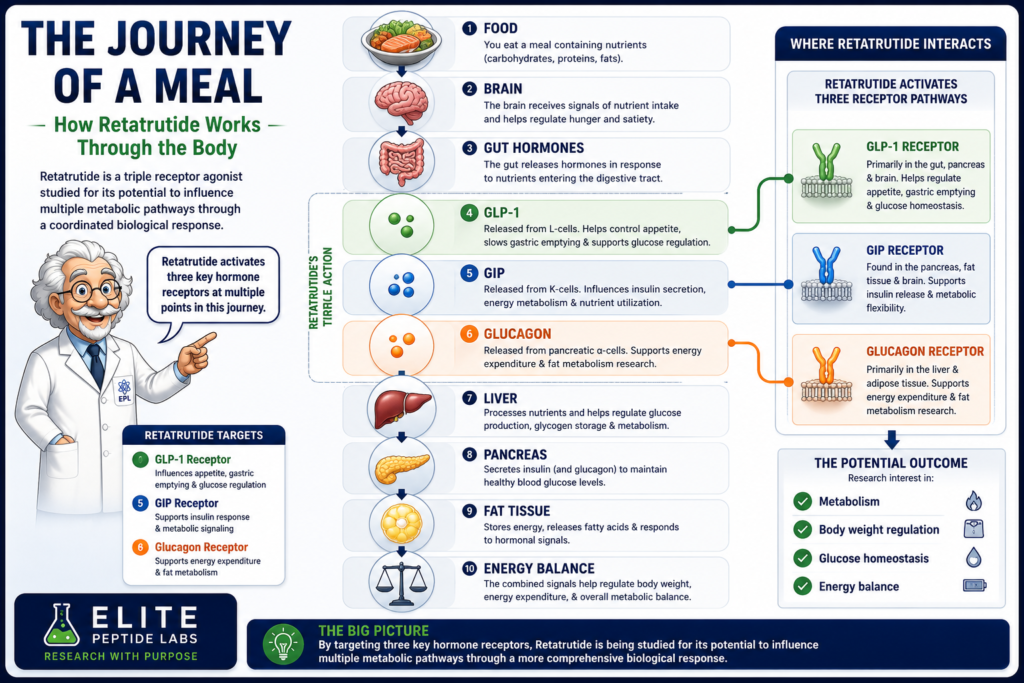
Building on decades of metabolic research
Retatrutide did not appear overnight.
It represents another step in a much longer scientific journey.
Researchers first spent years investigating hormones such as GLP-1, seeking to better understand their role in appetite signalling, glucose regulation, and digestive physiology.
As new evidence emerged, scientists expanded their investigations to include additional metabolic pathways, leading to the development of dual receptor agonists that could activate both GLP-1 and GIP simultaneously.
Retatrutide extends that concept one step further by incorporating a third biological target—the glucagon receptor—into the same investigational molecule.
That makes it one of the first extensively studied triple receptor agonists in metabolic research.
Importantly, this evolution reflects a change in scientific questions—not necessarily a conclusion about outcomes.
Each generation of investigational compounds has provided researchers with new ways to examine increasingly complex biological systems.
Why researchers became interested
The excitement surrounding Retatrutide is not simply because it is new.
Researchers are interested because it allows them to explore questions that were previously much more difficult to investigate.
For example:
- How do appetite-related hormones influence one another?
- What happens when multiple metabolic pathways are activated simultaneously?
- Can integrated signalling provide new insights into energy regulation?
- How do different organs coordinate their responses during changing nutritional states?
These are fundamental scientific questions.
Retatrutide serves as another research tool for studying them under controlled experimental conditions.
🧪 Professor Peptide
“Science rarely advances by finding bigger answers.
It advances by learning how to ask better questions.”
Research is a process—not a destination
One misconception often seen online is that a promising investigational molecule immediately becomes accepted scientific fact.
That is not how research works.
A new compound first generates hypotheses.
Those hypotheses are then tested through laboratory experiments.
Independent groups attempt to reproduce the findings.
Additional studies investigate different models, methodologies, and biological systems.
Only after a large body of consistent evidence accumulates does scientific confidence begin to strengthen.
Retatrutide is currently part of that ongoing process.
The body of research continues to grow, and scientists are actively studying its biological mechanisms across multiple areas of metabolic science.
As with every investigational peptide, today’s understanding may evolve as new evidence becomes available.
What makes Retatrutide different from earlier investigational peptides?
The defining characteristic of Retatrutide is not simply that it targets three receptors.
It is that those three receptors participate in interconnected systems responsible for coordinating metabolism throughout the body.
Instead of examining one signalling pathway in isolation, researchers can investigate how these pathways interact within a broader physiological network.
That systems-based approach has made Retatrutide one of the most closely followed investigational peptides in modern metabolic research.
Its significance lies not in definitive answers, but in the opportunity to generate new scientific knowledge.
Transition
Understanding where Retatrutide came from helps explain why researchers are interested in studying it.
The next question is equally important:
How does Retatrutide actually interact with the body’s biology?
To answer that, we’ll explore each of its three receptor targets individually—and then see how they work together as a coordinated signaling network.
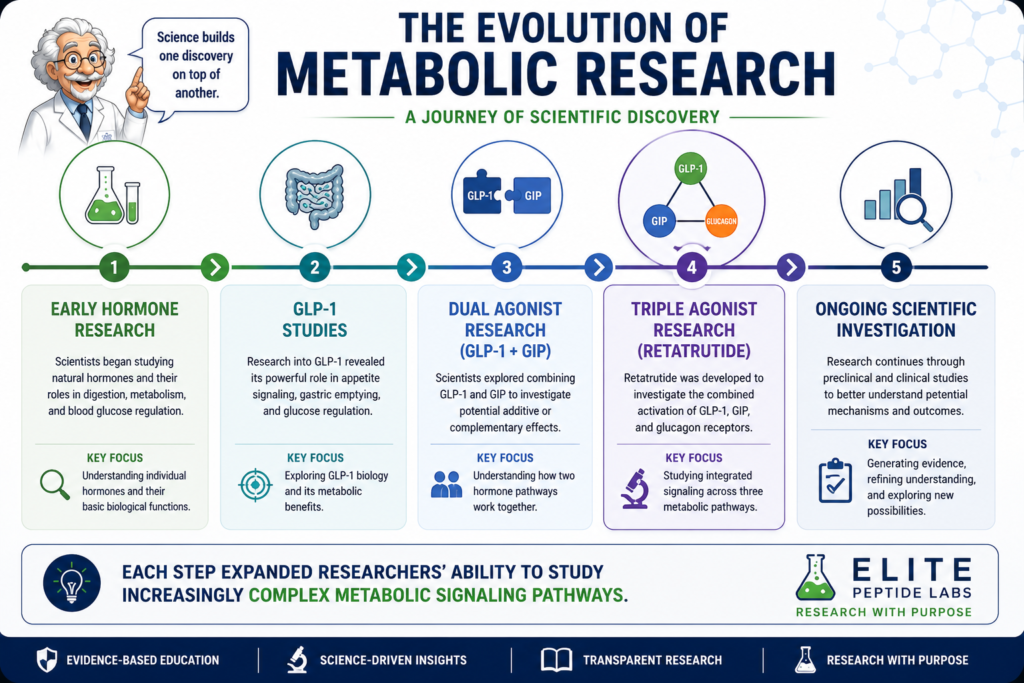
How Retatrutide Works: Understanding the Three Receptor Pathways
Now that we’ve explored why Retatrutide was developed, the next logical question becomes:
What actually happens when researchers investigate this molecule?
The answer isn’t a single biological effect.
Instead, Retatrutide is designed to interact with three separate receptor systems, each of which plays a different role in metabolic regulation.
Understanding these pathways individually makes it much easier to appreciate why scientists consider Retatrutide an interesting research tool.
Let’s examine each one.
1. GLP-1 Receptor
The appetite signalling pathway
GLP-1 (Glucagon-Like Peptide-1) is one of the body’s naturally occurring incretin hormones.
Following food intake, specialized cells within the intestine release GLP-1 as part of the normal digestive response.
Researchers have spent decades studying this pathway because it appears to influence several important physiological processes, including:
✔ Appetite signalling
✔ Gastric emptying
✔ Glucose regulation
✔ Communication between the gut and brain
Rather than acting in isolation, GLP-1 forms part of an extensive communication network that helps coordinate how the body responds after eating.
Because of its broad biological role, GLP-1 has become one of the most extensively investigated pathways in modern metabolic research.
🧪 Professor Peptide
“One receptor rarely tells the whole story.
Biology is a conversation between many signaling systems.”
2. GIP Receptor
A second layer of metabolic signalling
The second pathway studied in Retatrutide research involves GIP (Glucose-Dependent Insulinotropic Polypeptide).
Like GLP-1, GIP is naturally released after meals.
However, researchers believe it contributes differently to metabolic regulation.
Current investigations examine its possible involvement in:
• Nutrient sensing
• Insulin response
• Energy metabolism
• Communication between digestive organs and other tissues
Scientists continue exploring how GIP signalling interacts with GLP-1 rather than functioning independently.
That interaction is one reason dual agonist research attracted so much scientific interest before triple agonists such as Retatrutide were developed.
3. Glucagon Receptor
The third pathway
The third receptor distinguishes Retatrutide from earlier investigational molecules.
Glucagon has traditionally been associated with maintaining blood glucose during periods of fasting.
More recently, researchers have also become interested in its broader role within whole-body energy regulation.
Current laboratory investigations explore how glucagon receptor signalling may contribute to:
• Energy expenditure
• Fat metabolism
• Nutrient utilization
• Overall metabolic regulation
When combined with GLP-1 and GIP signalling, researchers can investigate how multiple physiological systems interact simultaneously rather than studying each pathway in isolation.
Bringing the three pathways together
This is the central idea behind Retatrutide.
Instead of focusing on one receptor at a time, researchers can investigate how three interconnected signalling systems influence metabolism together.
Importantly, this does not mean scientists have reached final conclusions.
Rather, it provides a more comprehensive experimental model for exploring complex biological questions.
The goal isn’t to prove a single outcome.
The goal is to better understand how these systems communicate.
That distinction is an important part of responsible scientific research.
Key Takeaways
By this point in the guide, you should understand that:
✔ Retatrutide is classified as a triple receptor agonist.
✔ It is being investigated because it interacts with GLP-1, GIP, and glucagon receptors.
✔ Each receptor contributes differently to metabolic regulation.
✔ Researchers are interested in how these pathways interact—not just how they function individually.
✔ Scientific understanding continues to evolve as additional studies are completed.
Transition
Knowing which receptors Retatrutide targets is only part of the story.
The next question is perhaps the most important:
What does the current scientific research actually show?
In the next section, we’ll examine the available evidence, explore what researchers have observed so far, and discuss where important questions still remain.
What Does the Current Research Say?
Separating scientific evidence from headlines
If you’ve searched for Retatrutide online, you’ve probably encountered bold claims.
Some articles describe it as revolutionary.
Others focus on dramatic headlines or isolated study results.
Some discussions go even further, presenting preliminary findings as though they were already established scientific fact.
Responsible research doesn’t work that way.
Every promising investigational molecule follows the same journey—from laboratory discovery, to preclinical investigation, to carefully designed clinical studies, and finally to independent replication over time.
Retatrutide is no exception.
Although the scientific literature has expanded rapidly, researchers continue collecting evidence to better understand how this investigational peptide behaves across different experimental settings.
The goal is not to reach conclusions quickly.
The goal is to reach conclusions that can withstand scientific scrutiny.
Why researchers are excited
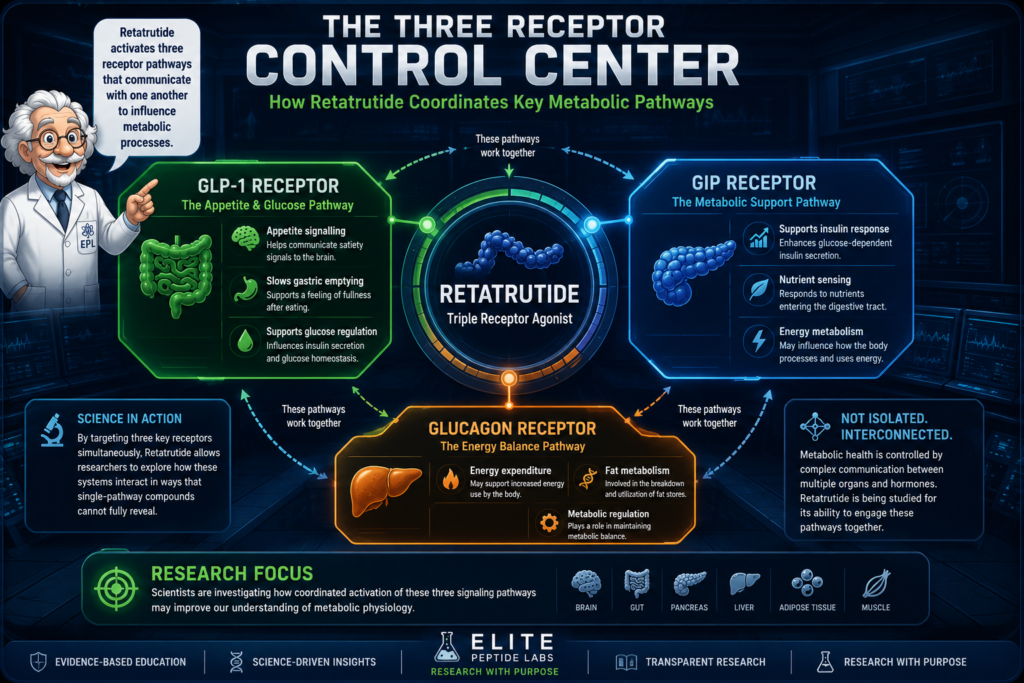
Retatrutide has attracted considerable attention because it combines three metabolic signalling pathways into a single investigational molecule.
That design allows researchers to explore questions that previously required studying multiple pathways independently.
Current research programs are investigating areas including:
✔ Regulation of energy balance
✔ Body weight physiology
✔ Glucose homeostasis
✔ Appetite signalling
✔ Metabolic adaptation
✔ Endocrine communication
Rather than proving one specific outcome, these studies seek to improve our understanding of how complex metabolic systems interact.
Every completed study adds another piece to a much larger scientific puzzle.
What scientists have observed so far
Across published research, investigators have reported findings that continue to shape scientific interest in Retatrutide.
Research has explored topics such as:
- Changes in body weight regulation within controlled study settings
- Appetite-related physiological signalling
- Glucose metabolism and endocrine responses
- Energy expenditure and metabolic adaptation
- Interactions between GLP-1, GIP, and glucagon receptor pathways
These observations have encouraged additional research.
However, they also raise new questions that require further investigation.
That is how science progresses.
Each study answers some questions while creating entirely new ones.
🧪 Professor Peptide
“One exciting study starts a conversation.
Many independent studies build scientific confidence.”
What researchers are still trying to understand
Scientific interest in Retatrutide extends well beyond the findings already published.
Current and future research continues investigating questions such as:
- How do the three receptor pathways influence one another over time?
- Which biological mechanisms contribute most significantly to observed metabolic changes?
- How consistent are findings across different experimental models?
- What variables influence differences between study outcomes?
- Which observations remain reproducible as additional research is completed?
These are the kinds of questions that move scientific understanding forward.
Rather than searching for certainty after one publication, researchers look for patterns that emerge across many carefully conducted studies.
Why independent replication matters
One of the strongest indicators of reliable science is reproducibility.
When independent research groups obtain similar findings using different methods and populations, confidence in those observations gradually increases.
Conversely, if results cannot be reproduced consistently, scientists revisit earlier assumptions and continue investigating.
That process may appear slow.
In reality, it is one of science’s greatest strengths.
Reliable knowledge is built through repeated observation—not isolated discoveries.
Retatrutide is currently progressing through that process, with researchers around the world continuing to evaluate its biological properties.
Understanding the difference between interest and evidence
Scientific interest should never be confused with scientific certainty.
A compound may generate significant attention because it introduces a novel research approach.
That does not mean every hypothesis will ultimately prove correct.
Similarly, promising early findings should be viewed as part of an evolving body of evidence rather than definitive conclusions.
The purpose of ongoing research is to challenge ideas, test assumptions, and refine scientific understanding over time.
That is precisely why Retatrutide continues to receive so much attention within the metabolic research community.
Key Takeaways
By this stage of the guide, you should understand that:
✔ Research on Retatrutide is expanding rapidly.
✔ Scientists are investigating multiple aspects of metabolic physiology—not a single outcome.
✔ Current evidence is encouraging continued research, but scientific understanding continues to evolve.
✔ Independent replication remains essential before strong scientific conclusions are reached.
✔ Responsible interpretation always distinguishes published evidence from speculation.
Transition
Now that we’ve explored what researchers have observed, another important question naturally follows:
How confident should we be in the current evidence?
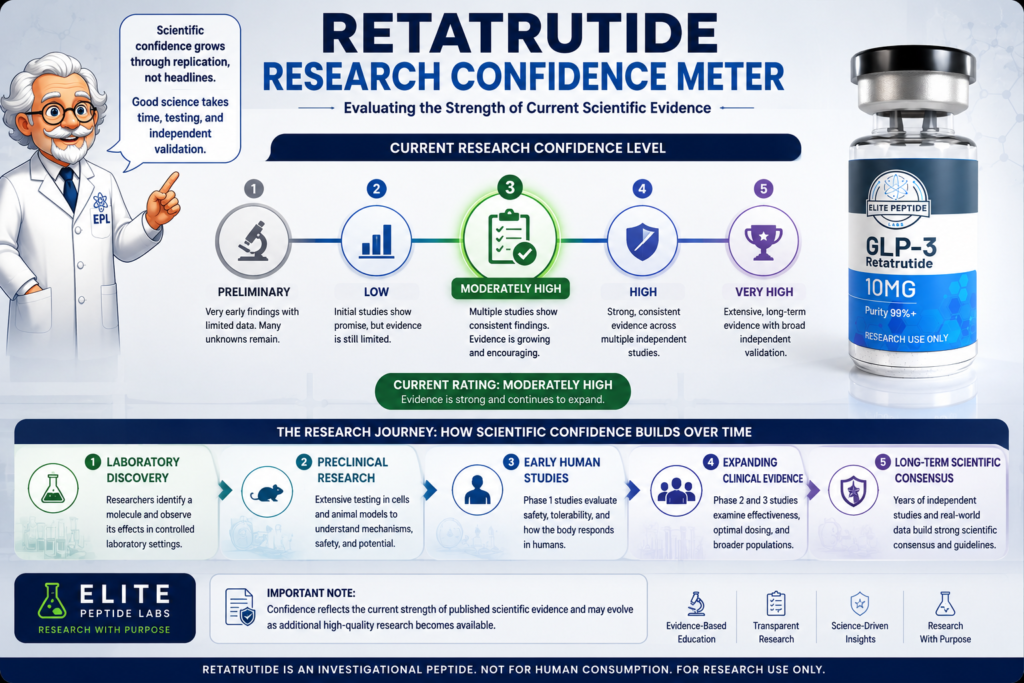
In the next section, we’ll introduce our Research Confidence Meter, explain how scientific confidence develops over time, and show where Retatrutide currently fits within that evidence continuum. This is one of the signature educational features of the Elite Peptide Labs Research Library and helps readers understand not just what the research says, but how much confidence scientists can reasonably place in it at this stage.
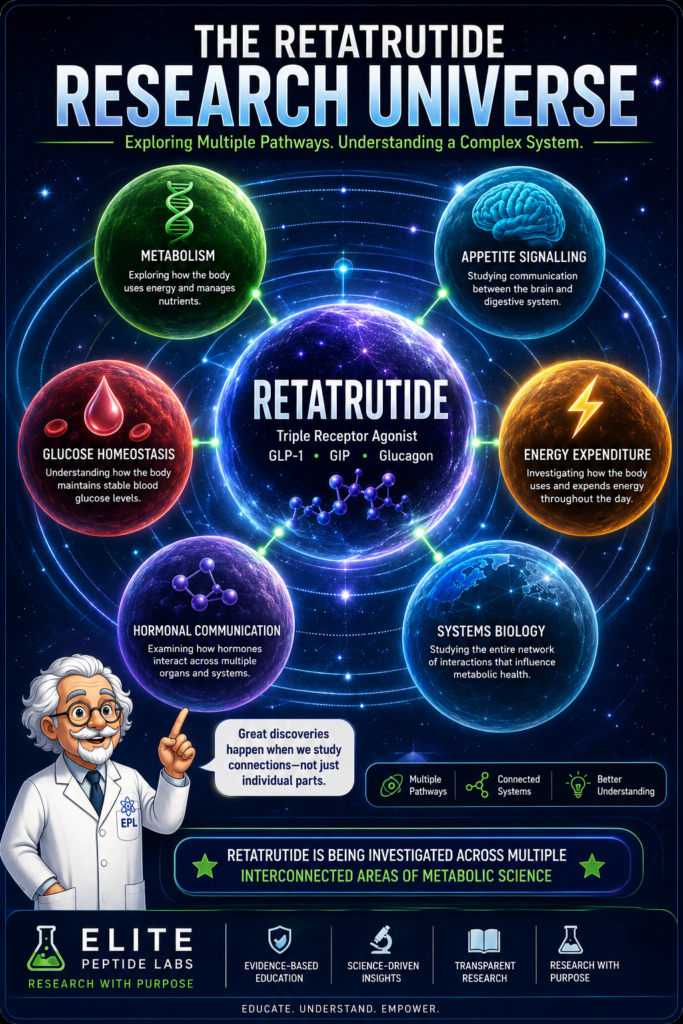
Major Areas of Retatrutide Research
One molecule. Many scientific questions.
Retatrutide is not being investigated because researchers expect it to answer a single question.
Quite the opposite.
Its unique triple receptor activity allows scientists to examine multiple aspects of metabolic physiology at the same time.
Rather than studying isolated biological systems, researchers can investigate how different organs, hormones, and signalling pathways communicate as part of an integrated network.
This systems-based approach has made Retatrutide one of the most widely discussed investigational peptides in modern metabolic science.
Let’s look at the primary areas currently being explored.
1. Metabolism
Understanding how the body uses energy
Metabolism refers to the countless chemical processes that allow the body to convert nutrients into usable energy.
Although metabolism is often discussed casually, it is actually one of the most complex biological systems researchers study.
Current investigations involving Retatrutide explore questions such as:
✔ How cells regulate energy use.
✔ How different organs coordinate metabolic activity.
✔ How multiple hormonal signals influence one another.
✔ How energy expenditure changes under different physiological conditions.
Rather than focusing on a single organ, researchers study metabolism as a coordinated whole-body process.
2. Appetite Regulation
Understanding the biology of hunger
One of the most extensively investigated areas involves appetite signalling.
Scientists continue studying how the brain and digestive system communicate before, during, and after food intake.
Research explores topics including:
• Satiety signalling
• Communication between the gut and brain
• Meal-related hormone release
• Behavioural responses to nutrient intake
These investigations help researchers better understand the biological mechanisms that influence eating behaviour.
🧪 Professor Peptide
“Hunger isn’t controlled by one organ.
It’s a conversation between the brain, the gut, hormones, and metabolism.”
3. Glucose Homeostasis
Maintaining metabolic balance
Another major area of investigation involves glucose homeostasis.
This refers to the body’s ability to maintain relatively stable blood glucose levels despite continual changes in food intake and energy demand.
Researchers are studying how coordinated activation of GLP-1, GIP, and glucagon pathways may influence:
• Endocrine signalling
• Insulin-related physiology
• Nutrient utilization
• Overall metabolic coordination
Understanding these processes may provide broader insight into metabolic regulation.
4. Energy Expenditure
Beyond calories
Scientists are also investigating how the body expends energy throughout the day.
Energy expenditure involves much more than physical activity.
It includes numerous biological processes such as:
✔ Cellular metabolism
✔ Heat production
✔ Organ function
✔ Baseline physiological activity
Researchers continue exploring how multiple signalling pathways may contribute to these complex systems.
5. Systems Biology
Looking at the entire network
Perhaps the most exciting aspect of Retatrutide research is that it encourages scientists to study metabolism as an interconnected system rather than a collection of isolated parts.
Instead of asking:
“What does this receptor do?”
Researchers increasingly ask:
“How do these receptors communicate with one another?”
This represents an important shift in modern metabolic research.
As biological understanding becomes more sophisticated, scientists are placing greater emphasis on interactions between systems rather than individual pathways alone.
Retatrutide provides another investigational model for exploring those relationships.
What all of these studies have in common
Although these research areas appear different, they are all connected by a common goal:
To better understand how the body’s metabolic signalling network functions as an integrated whole.
Every published study contributes another piece to that larger picture.
Some answer existing questions.
Others reveal entirely new questions that scientists had not previously considered.
That continuous cycle of discovery is what drives scientific progress.
Key Takeaways
By this point, you should understand that researchers are currently investigating Retatrutide in relation to:
✔ Metabolic physiology
✔ Appetite signalling
✔ Glucose homeostasis
✔ Energy expenditure
✔ Hormonal communication
✔ Systems biology
Together, these areas illustrate why Retatrutide has become one of the most actively studied investigational molecules in metabolic research.
Transition
Understanding what scientists are studying is important.
Equally important is understanding what Retatrutide is not.
The internet is filled with misconceptions, exaggerated claims, and misunderstandings about investigational peptides.
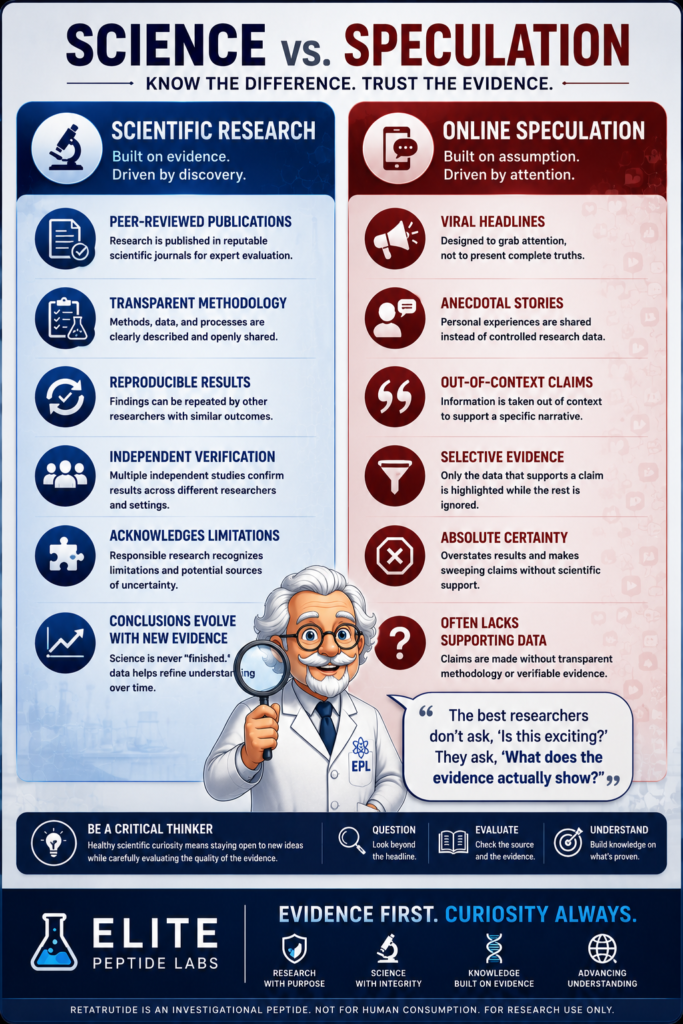
In the next section, we’ll separate scientific fact from common myths, helping readers distinguish responsible research from speculation.
Separating Scientific Evidence from Online Speculation
By now, you’ve probably noticed something.
The further you search for information about Retatrutide, the more difficult it becomes to separate established research from online speculation.
Some websites present balanced discussions supported by published evidence.
Others blur the line between scientific investigation, personal opinion, marketing, and social media trends.
To someone new to peptide research, they can look almost identical.
That’s exactly why learning how to evaluate information is just as important as learning about the peptide itself.
Why So Much Conflicting Information Exists
Scientific research moves carefully.
The internet moves quickly.
Researchers often spend years designing studies, collecting data, analyzing results, publishing findings, and allowing other scientists to evaluate their work.
Online discussions don’t work that way.
A single headline.
A short video.
One social media post.
An out-of-context quote.
Those can spread across the internet in a matter of hours.
By the time additional evidence becomes available, millions of people may already have accepted an early finding as fact.
That’s one reason scientific literacy has become so important.
Common Misunderstandings About Retatrutide
As interest in Retatrutide has grown, several misconceptions have become increasingly common.
Let’s examine a few of them.
❌ Myth:
“One exciting study proves everything.”
✅ Scientific Reality
Individual studies are valuable, but they represent only one piece of a much larger scientific picture.
Researchers look for consistency across multiple independent investigations before drawing strong conclusions.
Replication matters just as much as discovery.
❌ Myth:
“Every headline tells the whole story.”
✅ Scientific Reality
Headlines are designed to capture attention.
Scientific publications are designed to present evidence.
The most important information is often found in the methodology, statistical analysis, limitations, and discussion—not the headline.
❌ Myth:
“Researchers already know everything about Retatrutide.”
✅ Scientific Reality
Far from it.
Although the published literature has expanded rapidly, many important questions remain under active investigation.
Science is still evolving.
That is exactly why researchers continue conducting new studies.
❌ Myth:
“If something becomes popular online, the science must be settled.”
✅ Scientific Reality
Popularity is not scientific evidence.
Interest from the public often grows much faster than scientific consensus.
History has repeatedly shown that early excitement should always be evaluated alongside high-quality evidence.
How Scientists Evaluate New Evidence
When researchers encounter a new publication, they rarely ask:
“Is this exciting?”
Instead, they ask questions like:
✔ Was the study well designed?
✔ Was the sample size appropriate?
✔ Were the findings statistically significant?
✔ Have other researchers observed similar results?
✔ What limitations did the authors identify?
✔ Does the conclusion match the evidence presented?
Those questions help separate careful science from unsupported conclusions.
Professor Peptide Says
“Good researchers don’t chase exciting answers. They chase reliable evidence.”
A Better Way to Read Scientific Claims
One of the greatest skills any researcher can develop is healthy scientific curiosity.
That means staying open to new discoveries while remaining cautious about claims that move faster than the evidence.
Every published study adds another piece to the puzzle.
Some pieces reinforce what scientists already know.
Others challenge existing ideas.
Both are valuable.
The goal isn’t to become skeptical of every new finding.
The goal is to understand where that finding fits within the much larger body of scientific evidence.
That’s how scientific knowledge grows.
Looking Ahead
Now that we’ve explored how to distinguish scientific evidence from speculation, we can begin examining one of the questions readers ask most often:
What does current research actually suggest about Retatrutide’s role in metabolism, glucose regulation, appetite signalling, and energy balance—and just as importantly, what questions remain unanswered?
That’s where we’ll go next.
🎓Final Thoughts: Science Is a Journey, Not a Destination
By now, you’ve probably realized something important.
Retatrutide isn’t simply another peptide with an interesting name.
It represents one of the most ambitious areas of modern metabolic research, bringing together three biological signalling pathways into a single investigational molecule.
That alone makes it scientifically fascinating.
But perhaps the most important lesson from this guide isn’t about Retatrutide itself.
It’s about how science works.
Scientific understanding isn’t built overnight.
It grows through careful observation.
Well-designed experiments.
Independent verification.
Open discussion.
And thousands of researchers gradually adding new pieces to a much larger puzzle.
Every published study moves the field forward.
Sometimes by confirming previous discoveries.
Sometimes by challenging them.
Both outcomes are equally valuable.
What We’ve Learned
Throughout this guide we’ve explored:
✔ What Retatrutide is and why it differs from earlier investigational peptides.
✔ How GLP-1, GIP, and glucagon signalling work together within complex metabolic systems.
✔ Why researchers became interested in studying triple receptor agonists.
✔ How scientific confidence develops through replication—not headlines.
✔ The major areas where Retatrutide continues to be investigated.
✔ Why evidence should always take priority over speculation.
Most importantly…
You’ve learned how scientists evaluate research rather than simply accepting claims at face value.
That skill will remain valuable long after today’s research evolves.
The Future of Retatrutide Research
The scientific story of Retatrutide is still unfolding.
Every year, new laboratory findings, clinical investigations, and independent studies add to our understanding of metabolic physiology.
Some current hypotheses will become stronger.
Others may change as additional evidence becomes available.
That’s not uncertainty.
That’s progress.
Science doesn’t stand still.
Neither should our understanding of it.
Our Commitment at Elite Peptide Labs
At Elite Peptide Labs, we believe researchers deserve more than product pages.
They deserve clear explanations.
Evidence-based education.
Transparent discussion.
And resources that encourage curiosity instead of sensationalism.
That’s why every guide in our Research Library is created with one goal in mind:
To help readers better understand the science—not simply repeat the latest headline.
Whether you’re reading about Retatrutide, BPC-157, Semaglutide, Tesamorelin, NAD+, or any future investigational compound, our commitment remains the same.
Evidence first.
Questions always.
Scientific integrity above everything else.
🧪 About the Elite Peptide Labs Research Library
The Elite Peptide Labs Research Library was created with a simple goal:
To provide clear, evidence-based educational resources that help readers better understand peptide science.
Rather than focusing on sensational headlines or speculation, every Research Library edition is designed to:
📚 Explain complex scientific concepts in plain language.
🔬 Summarize current areas of laboratory research.
⚖️ Distinguish between ongoing investigation and established scientific understanding.
🧠 Encourage thoughtful evaluation of published evidence.
🌍 Promote scientific curiosity through responsible education.
As the library continues to grow, new editions will explore additional peptides, laboratory techniques, biological pathways, and emerging areas of scientific interest.
Whether you’re reading your first article or your fiftieth, our mission remains the same:
Help readers understand the science—not just the conversation surrounding it.
📖 Continue Exploring the Research Library
Science is a journey, and every article adds another piece to the puzzle.
Continue your exploration with:
📘 RL-001
How to Store Research Peptides Properly: A Complete Laboratory Guide
Learn best practices for storage conditions, temperature stability, lyophilized peptides, reconstituted solutions, and laboratory handling techniques.
📘 RL-002
Understanding BPC-157: Current Research, Scientific Interest & Frequently Asked Questions
What Researchers Know, What They’re Studying, and What Remains Unanswered
📘 RL-003
The Complete Research Guide to Retatrutide
(You’re here now)
📘 Coming Soon
🧬 How to understand a COA
🧬 Tirzepatide Research Guide
🧬 Semaglutide Research Guide
🧬 GHK-Cu Research Guide
🧬 MOTS-c Research Guide
🧬 NAD⁺ Research Guide
🧬 TB-500 Research Guide
🧬 Understanding Peptides: A Beginner’s Guide
🧬 How Scientists Read Research Papers
🧬 Veterinary Peptide Research: Current Areas of Investigation
…and many more.
🧪 Professor Peptide’s Final Note
“The best researchers aren’t the ones with all the answers—they’re the ones who never stop asking thoughtful questions. Every experiment, every published paper, and every new discovery helps move science one step forward.”
📋 Research Library Standards
Every article published within the Elite Peptide Labs Research Library is developed using the same editorial principles:
✅ Evidence-based educational content
✅ Plain-language scientific explanations
✅ Balanced discussion of current laboratory research
✅ Clear distinction between investigation and established conclusions
✅ Commitment to scientific integrity and continuous learning
These principles help ensure consistency across the entire Research Library and reflect our commitment to responsible scientific communication.
⚠️ Research Use Notice
The information presented throughout this guide is provided solely for educational and informational purposes.
Products referenced on the Elite Peptide Labs website are intended exclusively for laboratory research, analytical testing, and scientific investigation.
They are not intended for human or veterinary use, nor are they intended to diagnose, treat, cure, or prevent any disease.
Readers are encouraged to evaluate published scientific literature carefully and consult original research whenever possible.
References & Further Reading
Readers interested in exploring the scientific literature can begin with these reputable resources:
- Triple-Hormone Receptor Agonist Retatrutide for Obesity (Phase 2 Trial)
- PubMed indexed publication
- Eli Lilly Phase 2 Retatrutide Results
- Retatrutide in Type 2 Diabetes Research
- Review of Current Retatrutide Research
- Systematic Review and Meta-analysis of Retatrutide
Scientific understanding continues to evolve. Readers are encouraged to consult original peer-reviewed publications when evaluating ongoing areas of peptide research.
🌟 Thank You for Reading
Thank you for spending time with the Elite Peptide Labs Research Library.
Scientific understanding grows one question at a time.
We hope this guide has helped you better understand not only BPC-157, but also the scientific process itself.
We look forward to welcoming you back as our Research Library continues to expand.
Until then—
Stay curious. Keep learning. Follow the evidence.