

The Complete Guide to Reading a Certificate of Analysis (COA)

RL-004
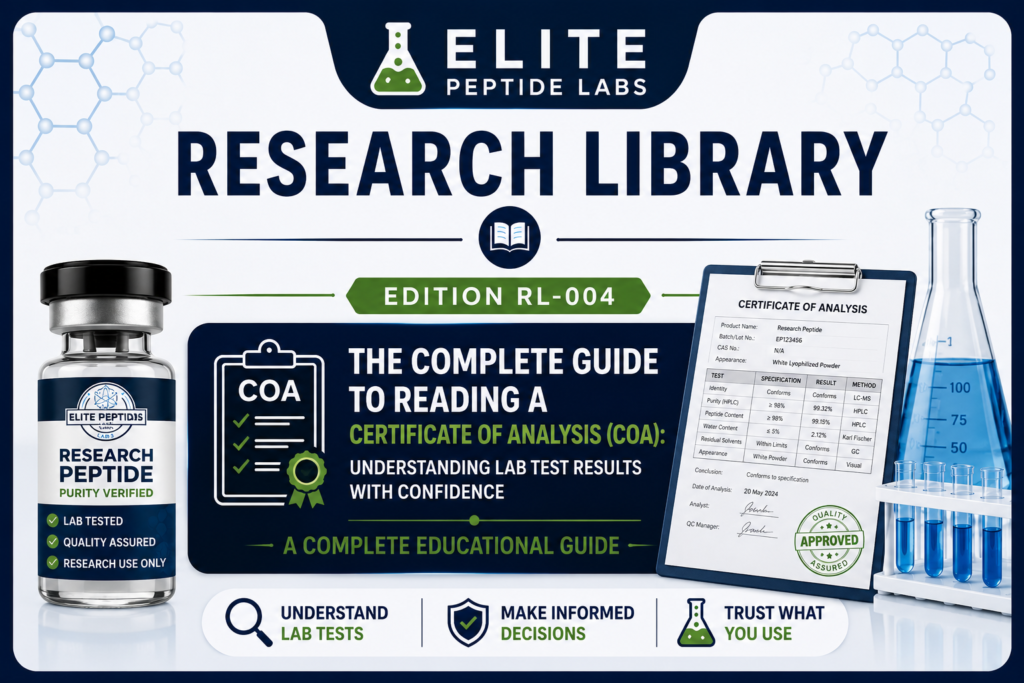
How to Read a Certificate of Analysis (COA)
Research Snapshot
| Reader Info | How to Read a Certificate of Analysis (COA) |
|---|---|
| 📖 Reading Time | ⏱ 21–26 Minutes |
| 🎯 Difficulty | 🟢 Beginner Friendly |
| 🧪 Category | Laboratory Guide |
| 📅 Last Updated | July 2026 Version 1.0 |
| 🏢 Published By | 📚 Elite Peptide Labs Research Library |
You’ve probably seen a Certificate of Analysis before…
Maybe it was attached to a research peptide product page.
Maybe a supplier proudly advertised:
“Every batch comes with a COA.”
Perhaps you’ve even downloaded one yourself.
At first glance, it certainly looks impressive.
Rows of laboratory data.
Technical terminology.
Purity percentages.
Analytical methods.
Official signatures.
Laboratory stamps.
For many researchers, that document immediately creates confidence.
But then a question naturally follows.
What does any of it actually mean?
Can you tell whether the document represents a well-tested research material…
…or simply recognize that it looks scientific?
How do laboratories use Certificates of Analysis?
Which sections matter most?
What should you verify before trusting the results?
And perhaps the most important question of all…
How can you tell the difference between a meaningful Certificate of Analysis and one that should prompt further questions?
That’s exactly why we created this guide on how to read a certificate of analysis.
The internet is full of suppliers displaying COAs.
Some provide excellent documentation.
Others provide very little context.
And many readers are left assuming that every Certificate of Analysis offers the same level of assurance.
The reality is more nuanced.
A COA is an important part of laboratory quality documentation—but like any scientific record, its value depends on understanding what it actually tells you, what it doesn’t, and how it fits into a broader quality assurance process.
Throughout this guide, we’ll walk through the purpose of Certificates of Analysis, explain how laboratories use them, identify the most important sections to review, and discuss the questions experienced researchers often ask before accepting analytical results.
Because understanding a document is far more valuable than simply downloading one.
Every good scientific investigation begins with one simple habit:
Looking beyond the headline… and reading the evidence.
⚡ Quick Answer
A Certificate of Analysis (COA) is a laboratory document that summarizes the analytical testing performed on a specific batch of material. Depending on the testing conducted, it may include information such as identity, purity, appearance, batch details, analytical methods, and whether the sample met predefined specifications. For research peptides, a COA serves as one component of a broader quality assurance process, helping researchers document and evaluate the materials used in their work.
🧪 Professor Peptide says:
“A Certificate of Analysis isn’t valuable because it looks official. It’s valuable because you understand what every line actually means.”
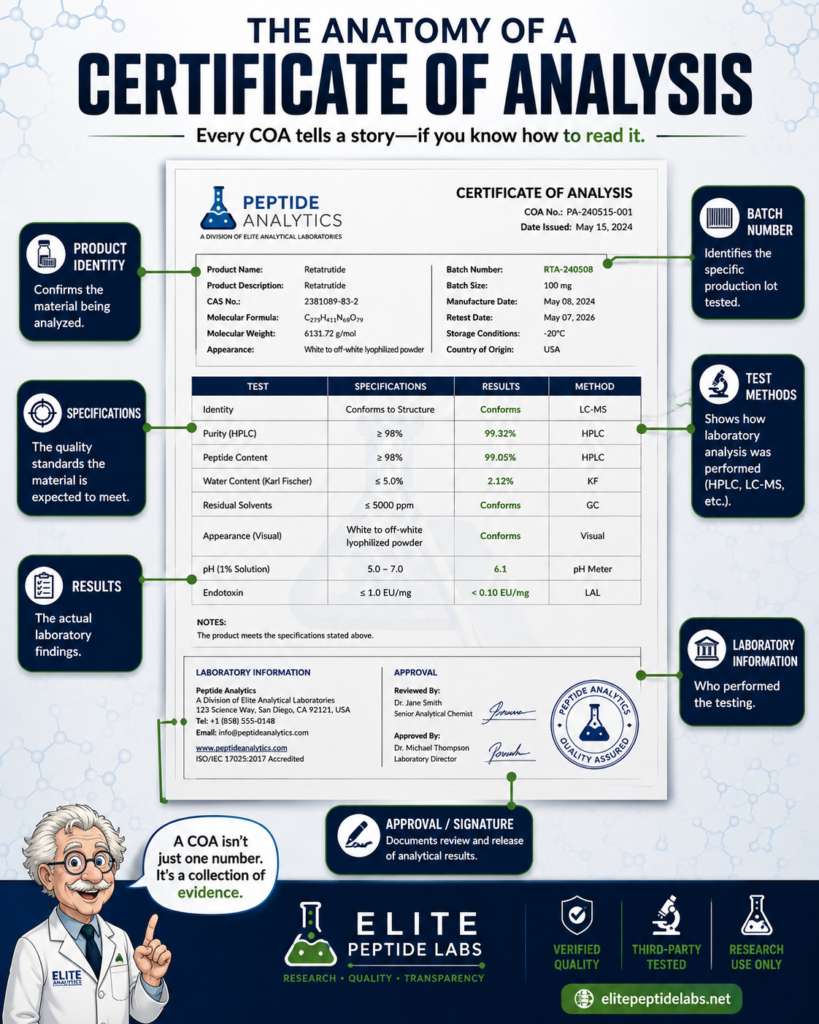
What Is a Certificate of Analysis?
More Than Just a Piece of Paper
At first glance, a Certificate of Analysis (COA) may look like nothing more than a technical laboratory report filled with numbers, abbreviations, and scientific terminology.
To many researchers, it can seem overwhelming.
To experienced laboratories, however, every section tells an important part of the story.
A properly prepared COA provides documented evidence describing the identity, quality, and analytical characteristics of a specific production batch. Rather than relying on marketing claims or product descriptions, researchers use these reports to review measurable laboratory findings generated through standardized analytical testing.
This is one of the reasons Certificates of Analysis have become an important part of quality assurance throughout pharmaceutical, biotechnology, and research laboratories around the world.
A COA doesn’t guarantee that a material is “perfect.”
Instead, it provides transparent documentation showing what was tested, how it was tested, and what results were obtained at the time of analysis.
Understanding this distinction is one of the first steps toward becoming a more informed consumer of scientific information.
Why Every Batch Has Its Own COA
One of the biggest misconceptions surrounding Certificates of Analysis is the belief that a single report applies forever.
In reality, reputable manufacturers generate COAs for individual production batches.
Every manufacturing lot is produced independently, which means each batch may undergo its own analytical testing before release.
That’s why you’ll often see a unique batch or lot number printed prominently near the top of every Certificate of Analysis.
This batch number connects the laboratory results directly to the specific material that was tested.
Without this connection, there would be no reliable way to verify that the published analytical results actually correspond to the product being reviewed.
For researchers, that traceability is just as important as the purity value itself.
Why Independent Testing Matters
Not every Certificate of Analysis carries the same level of scientific value.
Some COAs are generated by the manufacturer’s own internal laboratory.
Others are verified by independent third-party analytical laboratories with no direct involvement in producing the material.
Independent testing adds another layer of transparency because it allows analytical findings to be confirmed outside the manufacturing process.
This is why many experienced researchers place greater confidence in products that include independent laboratory verification alongside detailed analytical documentation.
The goal isn’t simply to obtain impressive numbers.
The goal is to create confidence that those numbers accurately reflect the material being analyzed.
💡 Professor Peptide
“Good science isn’t built on trust alone—it’s built on evidence that others can verify.”
Transition to the Next Section
Now that we understand what a Certificate of Analysis is, it’s time to explore the analytical methods behind it.
Terms like HPLC, LC-MS, and purity testing appear on almost every COA—but what do they actually mean?
In the next section, we’ll break down the most common laboratory testing methods into plain English so you’ll understand not only what is being measured, but why those measurements matter.
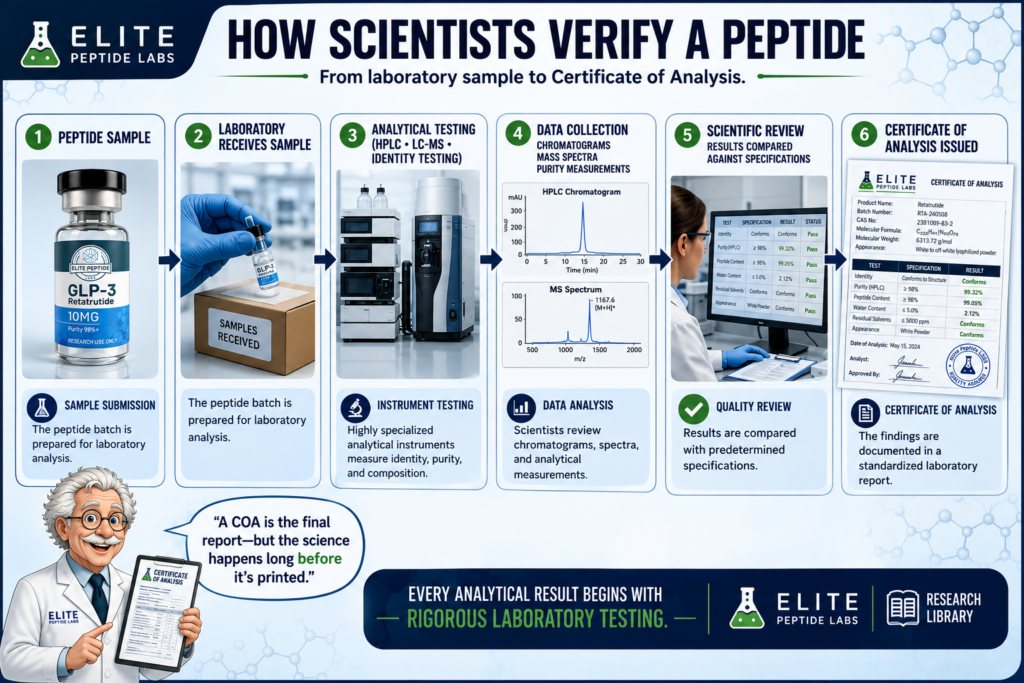
Understanding the Most Important COA Tests
Now that you know how a Certificate of Analysis is produced, it’s time to understand what you’re actually looking at.
At first glance, a COA can appear highly technical.
Rows of numbers.
Laboratory terminology.
Analytical methods.
Scientific abbreviations.
For someone seeing one for the first time, it can feel like reading another language.
Fortunately, it doesn’t have to.
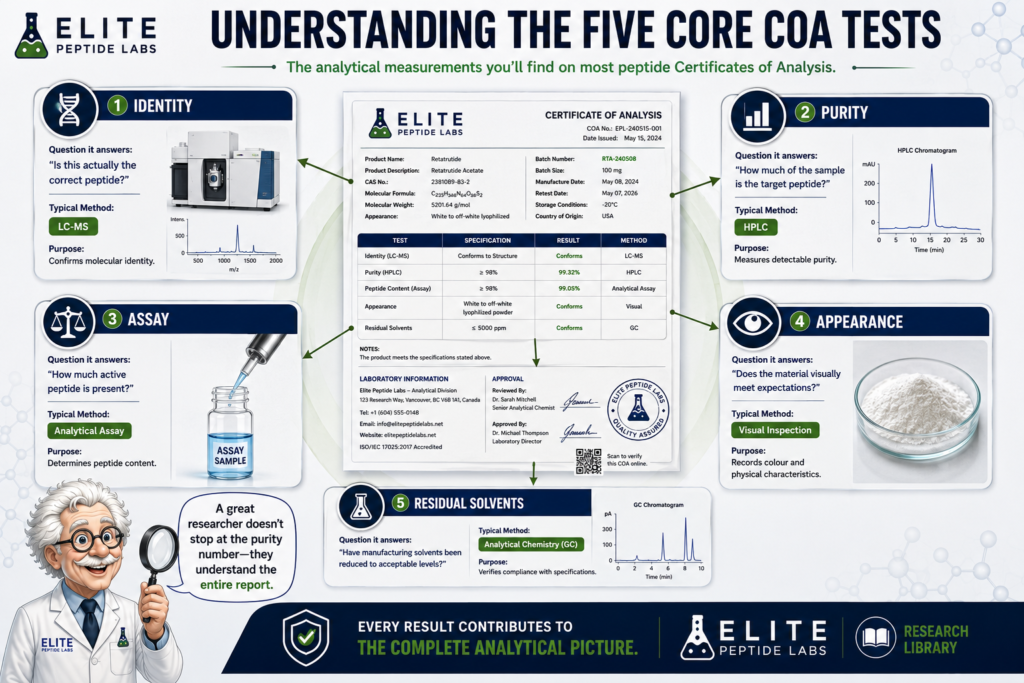
Most peptide Certificates of Analysis contain a core set of analytical results that appear again and again. Once you understand what these measurements represent, you’ll be able to evaluate a COA with far greater confidence—regardless of which laboratory produced it.
Let’s examine the most common sections you’ll encounter.
🧬 Identity Testing
The first question any laboratory asks is surprisingly simple:
“Is this actually the compound it claims to be?”
Identity testing is designed to answer that question.
Using sophisticated analytical techniques such as LC-MS (Liquid Chromatography–Mass Spectrometry), scientists compare the molecular characteristics of the sample against the expected molecular profile of the target peptide.
If those characteristics match within accepted analytical limits, the material is considered to conform to its expected identity.
Without confirming identity first, the rest of the analytical results have very little value.
📊 Purity (HPLC)
Purity is often the first number researchers notice on a Certificate of Analysis—and for good reason.
High Performance Liquid Chromatography (HPLC) separates the components within a sample and measures how much of the material consists of the intended peptide versus other detectable compounds.
A result of 99% purity indicates that the overwhelming majority of the detectable material corresponds to the target peptide under the conditions of the analysis.
However, it’s important to understand what this number does—and does not—represent.
Purity alone does not describe every aspect of product quality.
It does not replace identity testing.
It does not confirm sterility.
It does not evaluate endotoxins or every possible contaminant.
Instead, purity should be viewed as one important piece of a much larger analytical picture.
⚖️ Peptide Content (Assay)
Many Certificates of Analysis also include an assay or peptide content measurement.
This analysis estimates how much of the expected active peptide is present within the tested material.
Although closely related to purity, assay and purity are not identical measurements.
Purity describes how much of the detectable sample consists of the target compound, while assay focuses on the quantity of the intended peptide present according to the laboratory’s analytical method.
Understanding both values provides researchers with a more complete picture of the sample being evaluated.
👀 Appearance
One of the simplest sections on a COA is also one of the most important.
The laboratory records the physical appearance of the material before analytical testing.
For many lyophilized research peptides, this is commonly described as:
- White to off-white lyophilized powder
- White crystalline powder
- White solid
While appearance alone cannot verify quality, unexpected colour changes, visible contamination, or abnormal physical characteristics may indicate that additional investigation is warranted.
Appearance serves as an important first quality checkpoint before more advanced laboratory analyses begin.
🧪 Residual Solvents
During peptide synthesis, various solvents may be used throughout the manufacturing process.
Residual solvent testing measures whether trace amounts remain in the finished material and verifies that they fall within established analytical specifications.
On many COAs, you’ll see results reported as either measured concentrations or as a simple “Conforms” if the sample meets the laboratory’s predefined acceptance criteria.
Although this section often receives less attention than purity, it remains an important component of a comprehensive analytical evaluation.
Professor Peptide 💬
“Think of a Certificate of Analysis like a detective’s case file. No single clue solves the mystery—but together, the evidence tells the story.”
Transition to the next section
By now, you’ve probably noticed something important.
A Certificate of Analysis contains much more than a single purity percentage.
But there’s another question many researchers eventually ask:
“What about sterility, endotoxins, heavy metals, and other contaminants?”
The answer is that not every COA includes every possible analytical test.
In the next section, we’ll explore the additional testing that may be performed beyond standard purity analysis—and why understanding those differences can help you evaluate a supplier with greater confidence.
Beyond Purity: Understanding Additional Quality Testing
By now, you’ve probably noticed something interesting.
When people discuss peptide quality online, one number tends to dominate the conversation:
Purity.
It’s easy to understand.
Easy to compare.
Easy to advertise.
But experienced researchers know that evaluating a material involves much more than a single percentage.
Depending on the purpose of the analysis, the laboratory performing the work, and the testing package requested, additional analytical evaluations may also be performed to provide a broader understanding of the material.
Not every Certificate of Analysis includes every possible test.
That doesn’t automatically indicate that something is missing or wrong.
Instead, it reflects the scope of testing requested for that particular batch.
Understanding these additional analyses can help researchers interpret a COA more thoughtfully and ask better questions when evaluating laboratory documentation.
🧫 Endotoxin Testing
Endotoxins are naturally occurring components associated with certain bacteria.
When testing is requested, laboratories may measure endotoxin levels using validated analytical methods to determine whether they fall within predefined specifications.
Not every peptide COA includes endotoxin testing, but it may appear as part of more comprehensive analytical packages or specialized quality programs.
🦠 Sterility Testing
Sterility testing evaluates whether viable microorganisms are detected under defined laboratory testing conditions.
This type of analysis is not routinely included on every research peptide COA and depends on the intended analytical scope and laboratory procedures.
If sterility testing has been performed, the results are typically reported as either meeting or not meeting the established acceptance criteria.
⚙️ Heavy Metal Screening
Modern analytical laboratories may also screen for trace levels of heavy metals using highly sensitive instrumentation.
These analyses help determine whether elements such as lead, cadmium, arsenic, or mercury are present above established analytical thresholds.
When included, heavy metal testing provides another layer of information that contributes to the overall analytical profile of the material.
💧 Moisture Content
Many research peptides are supplied as lyophilized powders.
Because moisture can influence stability and handling characteristics, laboratories may evaluate residual water content using specialized analytical techniques.
Recording moisture content helps build a more complete understanding of the sample’s physical properties.
🧪 Stability Studies
Some manufacturers and laboratories perform stability studies to observe how materials respond to different storage conditions over time.
These investigations may examine factors such as temperature, humidity, light exposure, and long-term storage.
Rather than producing a single measurement, stability studies help researchers understand how analytical characteristics may change under defined conditions.
📋 Why These Tests Matter
Not every research project requires every possible analytical test.
Likewise, not every Certificate of Analysis is designed to answer every scientific question.
A COA should be viewed as a record of the analyses that were performed—not as a complete evaluation of every conceivable quality attribute.
This is one reason why experienced researchers often look beyond a single purity percentage and review the document as a whole.
The more complete the analytical documentation, the greater the confidence researchers can have in understanding exactly what was measured—and what was not.
💬 Professor Peptide
“Good science isn’t about finding one impressive number. It’s about understanding the full body of evidence.”
Transition to the Next Section
Now that you understand both the core analytical tests and the additional quality evaluations that may appear on a Certificate of Analysis, there’s one final skill that separates experienced researchers from everyone else:
Knowing how to recognize a high-quality COA—and spotting the warning signs when something doesn’t look quite right.
In the next section, we’ll walk through the practical checklist researchers can use to evaluate a Certificate of Analysis with confidence.
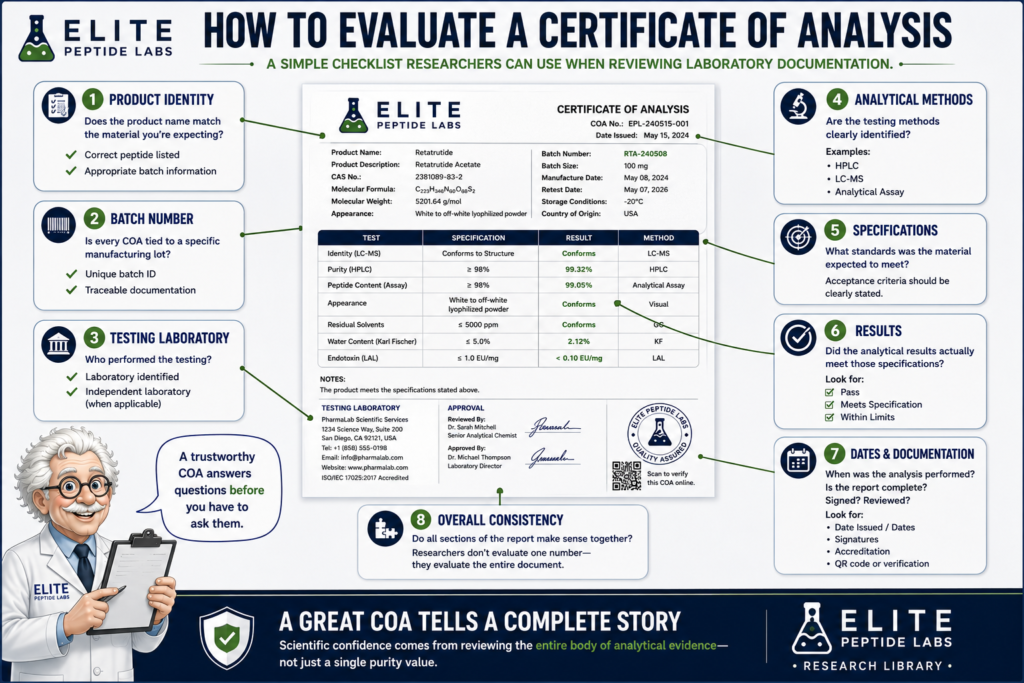
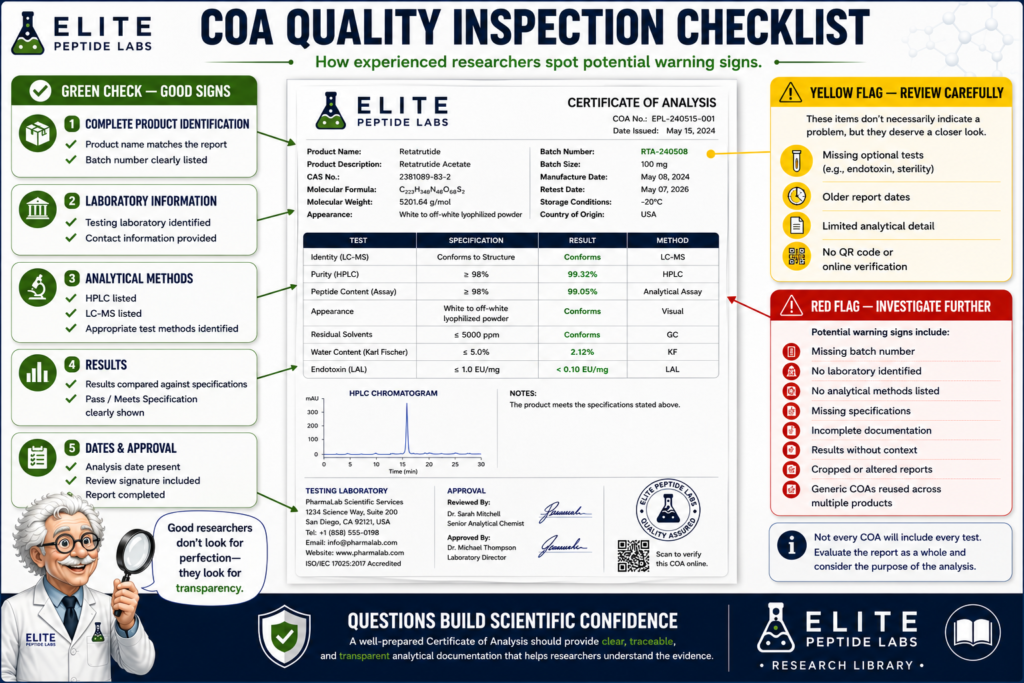
Common Red Flags to Watch For When Reviewing a Certificate of Analysis
One of the greatest strengths of scientific research is that it encourages questions.
A Certificate of Analysis should provide answers—not create new uncertainties.
While no laboratory report is perfect, experienced researchers learn to look beyond the headline numbers and evaluate the document as a whole.
Rather than searching for a single “magic” purity percentage, they ask whether the report is complete, internally consistent, and supported by appropriate analytical documentation.
Here are several practical observations researchers often consider when reviewing a Certificate of Analysis.
🚩 Missing Batch Information
Every COA should be linked to a specific production batch or lot.
Without batch identification, it becomes difficult to determine exactly which material was analyzed or whether the report corresponds to the product being reviewed.
Traceability is one of the foundations of quality documentation.
🚩 Unclear Testing Methods
A laboratory report should clearly identify the analytical techniques used to generate its results.
Methods such as HPLC, LC-MS, analytical assays, or other validated procedures provide important context for interpreting the findings.
If testing methods are not identified, researchers have less information available to understand how the reported results were obtained.
🚩 Missing Laboratory Information
Quality documentation should identify the laboratory responsible for performing the analysis.
This typically includes the laboratory name and, in many cases, additional identifying information such as contact details or accreditation references.
Knowing who performed the analysis helps establish transparency.
🚩 Incomplete Documentation
Researchers often review whether a COA includes the supporting elements expected in a professional analytical report.
Examples may include:
- Analysis dates
- Review or approval signatures
- Specifications
- Report numbers
- Complete analytical results
Missing documentation does not automatically invalidate a report, but complete records generally provide greater confidence in the analytical process.
🚩 Results Without Context
A purity value, by itself, tells only part of the story.
Understanding what specifications were established, which methods were used, and whether the reported values met those specifications provides far more meaningful insight than focusing on a single percentage alone.
Scientific interpretation always depends on context.
🚩 Absolute Claims
Perhaps the biggest red flag isn’t found on the COA itself—it’s found in how the results are presented.
Science rarely deals in absolutes.
Responsible scientific communication acknowledges both what the available evidence demonstrates and what remains uncertain.
Researchers should be cautious of claims that present analytical results as unquestionable proof without appropriate context or supporting documentation.
The Best Approach
The goal isn’t to approach every Certificate of Analysis with suspicion.
It’s to approach each one with curiosity.
A well-prepared COA should answer important questions, provide transparent analytical information, and allow researchers to evaluate the evidence for themselves.
The more complete the documentation, the easier it becomes to understand what was measured, how it was measured, and what the results actually mean.
💬 Professor Peptide
“The strongest evidence doesn’t ask you to trust it—it gives you the information to verify it.”
Transition to the next section
By now, you’ve learned how Certificates of Analysis are created, what information they contain, and how experienced researchers evaluate them.
To finish this guide, let’s answer some of the most common questions researchers have about COAs and laboratory testing.
Frequently Asked Questions About Certificates of Analysis
Even after learning how a Certificate of Analysis is created and how to interpret its contents, researchers often have additional questions.
Some are surprisingly simple.
Others require a bit more context.
Below are answers to some of the most common questions about Certificates of Analysis and laboratory testing.
❓ Does every Certificate of Analysis look the same?
No.
There is no single universal template that every laboratory must follow.
Different testing laboratories may organize their reports differently, use different layouts, or present analytical results in slightly different formats.
However, regardless of appearance, a well-prepared COA should still communicate the same essential information: what was tested, how it was tested, the results obtained, and whether those results met the established specifications.
The format may vary—but scientific transparency should not.
❓ Is a higher purity percentage always better?
Not necessarily.
Purity is an important analytical measurement, but it represents only one aspect of a material’s overall analytical profile.
Researchers also consider identity testing, analytical methods, specifications, assay results, documentation quality, and—in some cases—additional testing such as residual solvents, endotoxins, or heavy metal analysis.
Evaluating a Certificate of Analysis involves understanding the complete body of evidence rather than focusing on a single number.
❓ Should every COA include every possible analytical test?
No.
The scope of testing depends on the laboratory, the analytical package requested, and the purpose of the evaluation.
Some Certificates of Analysis focus primarily on identity and purity, while others include a broader range of analytical measurements.
A COA documents the testing that was performed—it is not necessarily intended to include every analytical test that could be conducted.
❓ Why do some laboratories use HPLC while others use LC-MS?
Different analytical techniques answer different scientific questions.
For example, HPLC is commonly used to evaluate purity by separating components within a sample, while LC-MS combines chromatographic separation with mass spectrometry to help confirm molecular identity.
Rather than competing methods, these techniques often complement one another by providing different types of analytical information.
❓ Can a Certificate of Analysis expire?
A Certificate of Analysis represents the results obtained when a specific batch was analyzed.
The report itself does not typically “expire.”
However, researchers may consider factors such as the product’s storage conditions, manufacturing date, and the age of the analytical report when interpreting the information.
For this reason, many organizations periodically generate updated analytical documentation for new production batches.
❓ Why are batch numbers so important?
Batch numbers connect analytical results to a specific production lot.
Without this traceability, it becomes much more difficult to determine whether the Certificate of Analysis corresponds to the material being evaluated.
Traceability is one of the key principles of quality assurance and scientific documentation.
❓ What does “Meets Specification” actually mean?
This phrase indicates that the measured analytical result falls within the predefined acceptance criteria established for that test.
It does not necessarily imply that the material is “perfect” or that every possible characteristic has been evaluated.
Instead, it means that, based on the tests performed, the reported result satisfied the specified analytical requirements.
❓ Why do some companies provide QR codes on their COAs?
Some manufacturers and laboratories include QR codes that link to online verification pages, digital copies of reports, or additional batch information.
While QR codes can improve convenience and traceability, they are one part of a broader quality documentation system and should be considered alongside the rest of the Certificate of Analysis.
The Bigger Picture
Every Certificate of Analysis represents the outcome of a carefully designed analytical process.
Learning how to interpret these reports allows researchers to move beyond marketing claims and focus on what matters most:
The evidence itself.
Scientific understanding grows through careful observation, thoughtful analysis, and a willingness to ask informed questions.
A Certificate of Analysis is one of the many tools that helps researchers do exactly that.
💬 Professor Peptide
“Every great researcher starts by asking questions. Every better researcher learns where to find the answers.”
Transition to the Final Section
Now that you’ve learned how to read, evaluate, and think critically about Certificates of Analysis, let’s bring everything together and explore why analytical transparency remains one of the cornerstones of responsible scientific research.
Conclusion
Scientific Confidence Begins With Understanding
At first glance, a Certificate of Analysis may seem like little more than a technical laboratory document.
A collection of tables.
A few percentages.
Some unfamiliar scientific terminology.
But as you’ve seen throughout this guide, a COA is much more than that.
It is a record of evidence.
A snapshot of laboratory analysis.
A document that helps researchers understand not only what was measured, but how those measurements were obtained.
Learning to read a Certificate of Analysis isn’t about memorizing technical terms or chasing the highest purity percentage.
It’s about developing the ability to ask better questions.
Who performed the testing?
Which analytical methods were used?
Do the reported results meet the established specifications?
Does the documentation tell a complete, transparent, and internally consistent story?
These are the kinds of questions that strengthen scientific thinking.
Because science has never been built on assumptions.
It has always advanced through careful observation, critical evaluation, and a commitment to following the evidence wherever it leads.
Why This Matters
Whether you’re completely new to peptide research or have spent years reading scientific literature, one principle remains the same:
Knowledge grows through understanding—not speculation.
Every chromatogram.
Every laboratory measurement.
Every analytical method.
Every Certificate of Analysis.
Each one represents another opportunity to better understand the science.
That commitment to evidence is what transforms information into understanding—and understanding into better research.
🧪 About the Elite Peptide Labs Research Library
The Elite Peptide Labs Research Library was created with a simple goal:
To provide clear, evidence-based educational resources that help readers better understand peptide science.
Rather than focusing on sensational headlines or speculation, every Research Library edition is designed to:
📚 Explain complex scientific concepts in plain language.
🔬 Summarize current areas of laboratory research.
⚖️ Distinguish between ongoing investigation and established scientific understanding.
🧠 Encourage thoughtful evaluation of published evidence.
🌍 Promote scientific curiosity through responsible education.
As the library continues to grow, new editions will explore additional peptides, laboratory techniques, biological pathways, and emerging areas of scientific interest.
Whether you’re reading your first article or your fiftieth, our mission remains the same:
Help readers understand the science—not just the conversation surrounding it.
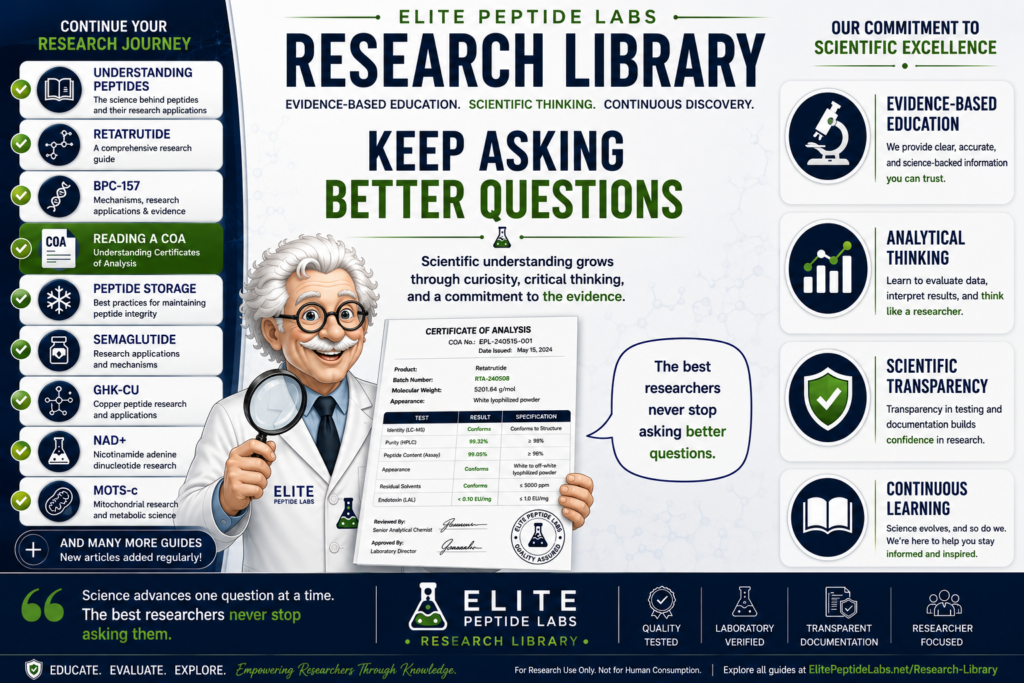
📖 Continue Exploring the Research Library
Science is a journey, and every article adds another piece to the puzzle.
Continue your exploration with:
📘 RL-001
How to Store Research Peptides Properly: A Complete Laboratory Guide
Learn best practices for storage conditions, temperature stability, lyophilized peptides, reconstituted solutions, and laboratory handling techniques.
📘 RL-002
Understanding BPC-157: Current Research, Scientific Interest & Frequently Asked Questions
What researchers know, what they’re studying, and what remains unanswered.
📘 RL-003
The Complete Research Guide to Retatrutide – RL-003
Understanding One of the Most Exciting Areas of Modern Metabolic Research
📘 RL-004
How to Read a Certificate of Analysis (COA) – RL-004
(You’re here now)
📘 Coming Soon
🧬 Semax Research Guide
🧬 Tirzepatide Research Guide
🧬 Semaglutide Research Guide
🧬 GHK-Cu Research Guide
🧬 MOTS-c Research Guide
🧬 NAD⁺ Research Guide
🧬 TB-500 Research Guide
🧬 Understanding Peptides: A Beginner’s Guide
🧬 How Scientists Read Research Papers
🧬 Veterinary Peptide Research: Current Areas of Investigation
…and many more.
🧪 Professor Peptide’s Final Note
“The best researchers aren’t the ones with all the answers—they’re the ones who never stop asking thoughtful questions. Every experiment, every published paper, and every new discovery helps move science one step forward.”
📋 Research Library Standards
Every article published within the Elite Peptide Labs Research Library is developed using the same editorial principles:
✅ Evidence-based educational content
✅ Plain-language scientific explanations
✅ Balanced discussion of current laboratory research
✅ Clear distinction between investigation and established conclusions
✅ Commitment to scientific integrity and continuous learning
These principles help ensure consistency across the entire Research Library and reflect our commitment to responsible scientific communication.
⚠️ Research Use Notice
The information presented throughout this guide is provided solely for educational and informational purposes.
Products referenced on the Elite Peptide Labs website are intended exclusively for laboratory research, analytical testing, and scientific investigation.
They are not intended for human or veterinary use, nor are they intended to diagnose, treat, cure, or prevent any disease.
Readers are encouraged to evaluate published scientific literature carefully and consult original research whenever possible
References & Further Reading
Readers interested in exploring the scientific literature can begin with these reputable resources:
- FDA — Synthetic Peptides Guidance
- ICH Q3C — Residual Solvents Guideline
- FDA – ICH Q3C Maintenance Procedures
- EMA Guideline on the Development and Manufacture of Synthetic Peptides
- United States Pharmacopeia (USP)
- International Council for Harmonisation (ICH)
- National Center for Biotechnology Information (NCBI)
Scientific understanding continues to evolve. Readers are encouraged to consult original peer-reviewed publications when evaluating ongoing areas of peptide research.
🌟 Thank You for Reading
Thank you for taking the time to explore this guide on understanding Certificates of Analysis.
We hope it has given you not only a better understanding of how laboratory reports are structured, but also a deeper appreciation for the role that analytical transparency plays in scientific research.
Every question you ask.
Every paper you read.
Every Certificate of Analysis you evaluate.
Brings you one step closer to becoming a more informed researcher.
And that’s a journey worth continuing.